Rockwell, Samuel Forbes. Davis Families of Early Roxbury and Boston. North Andover, Mass., 1932.
Based on the genealogical records of early Roxbury and Boston, the story of the petition for Jane Davis offers a poignant glimpse into the social dynamics and legal struggles of the year 1700.
The narrative begins with the death of the patriarch, William Davis, on December 9, 1683 [1]. While William left a respectable estate valued at £429, consisting largely of house and land, he also left a widow, Jane Davis, with nine children of her own to raise, the eldest being only fourteen [1]. Consequently, as the children aged, it became necessary for them to enter service to support the family.
Jane Davis, the daughter, who was born on December 24, 1670, and baptized in 1673, eventually went into service in the household of William Heath [1], [2]. Heath was the son of Peleg Heath and had been a widower since the death of his wife, Hannah, in 1697 [3].
The conflict arose on May 6, 1699, when Jane Davis gave birth to a child [4]. She claimed that her master, William Heath, was the father; Heath, who had remarried a Mrs. Anna Ruggles in 1699, denied the accusation [4], [3]. The paternity dispute escalated to the Massachusetts Supreme Court in October 1699 (Case No. 3965), but the court reached no immediate resolution [2].
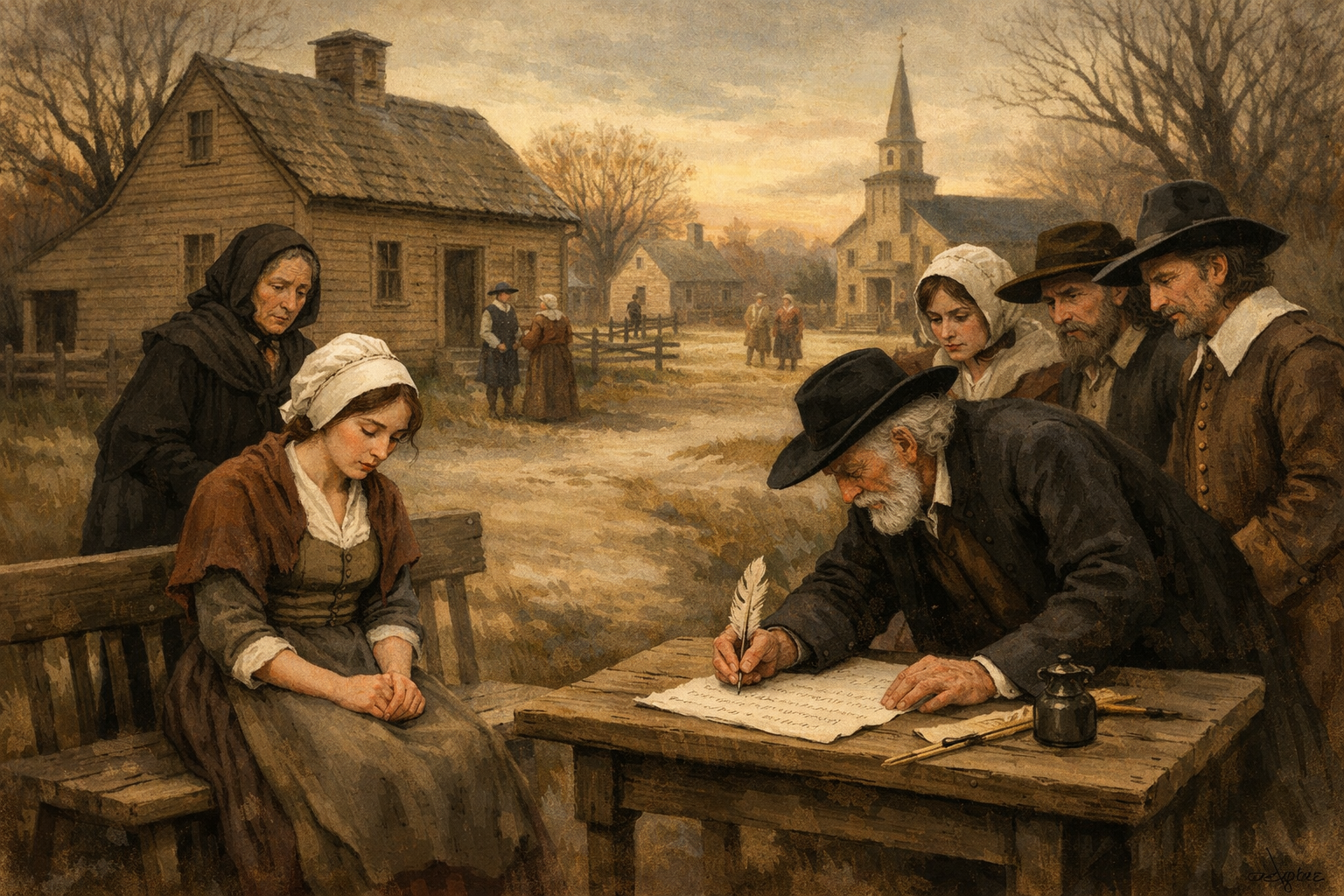
It was in this context that the community rallied around the Davis women. On April 2, 1700, twenty-six neighbors signed and presented a petition to the selectmen of Roxbury regarding the case [2], [5]. This document provides a vivid character reference for both the mother and the daughter.
The petitioners described Jane’s mother as a “godly grave” woman and a “poor sorrowful widow” [6]. Regarding the younger Jane, the neighbors testified that she was “weak in body” and “down in spirit” [6]. They strongly defended her reputation, stating that in their acquaintance with her, she had always been “diligent in her calling,” “true in her work,” and “chaste in her conversation” [6].
The neighbors asserted they had never seen anything to the contrary in her behavior until, as Jane claimed, “her master William Heath beguiled her” [6]. The petition concluded with a plea that, based on her previous good character and the difficult circumstances of the widow, Jane might have “the privilege of the Law” in her pursuit of justice [5].
Here is the text of the petition presented to the selectmen of Roxbury on behalf of Jane Davis, as recorded in the Massachusetts Supreme Court records (Case No. 4665):
“Roxbury April ye 2d 1700
We whose names are hereunto subscribed, knowing the burden which Jane Davis junr our neighbor is now laboring under, her mother being a godly grave, and at present a poor sorrowful widow, and the said Jane being weak in body, and down in spirit, some of us with whom she hath lived and others who are inhabitants of the Town of Roxbury, who have been well acquainted with her carriage & behavior, account ourselves bound in duty to say on her behalf, that she was always diligent in her calling and true in her work & chaste in her conversation; we say that we never saw or heard anything to the contrary, until (as she says) her master William Heath beguiled her. And therefore upon these reasons we pray that she may have the privilege of the Law.” [1], [2]
The record notes that this document was signed by twenty-six individuals [2].


Leave a Reply