Rockwell, Samuel Forbes. Davis Families of Early Roxbury and Boston. North Andover, Mass., 1932.
The “Hunt for the Davis Seal” is a perfect example of how heraldic evidence can bridge the gap between American colonists and their English origins. This specific investigation was undertaken to validate the link between the Davis family of Roxbury, Massachusetts, and the ancient Davis family of Tickenham, Somerset, England.
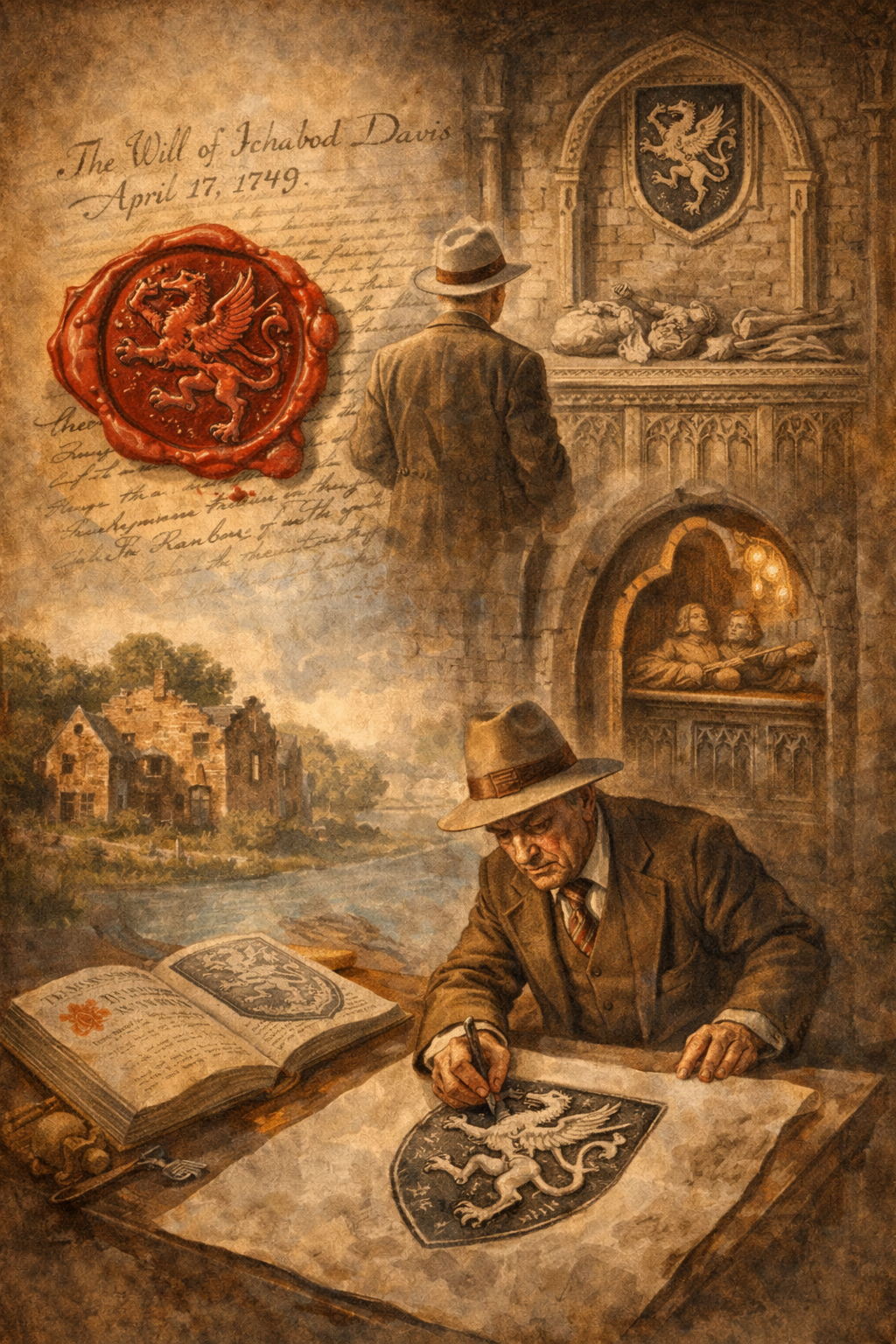
The mystery began with a red wax seal found on the will of Ichabod Davis of Roxbury, dated April 17, 1749 [1]. The seal displayed a specific heraldic device: a “griffin segreant” (a griffin in a rampant position) [2], [3]. Genealogists believed this coat of arms belonged to the Davis family of Caermarthen, Wales, and their descendants in Somerset, specifically a Rees (or Rice) Davis [4].
In 1925, Mr. Charles F. White of Brookline, Massachusetts—a descendant of the immigrant William Davis—traveled to England to find physical proof of this connection [5], [6]. His search began in Tickenham, Somerset, where he hoped to find the coat of arms carved on the mantel of the ruined manor house of Rees Davis [4]. However, his initial search on a Tuesday proved to be “fruitless” [6].
The breakthrough occurred that night through a “chance word” that put Mr. White in contact with Mr. Masters, an archaeologist from Flax Bonton [6]. Masters provided White with the history of the Tickenham manor but directed him to a different location for the evidence he sought: Backwell Church [7].
Following this lead, Mr. White visited Backwell Church and entered the “Rodney Chapel” [7]. There, he found the burial place of Rees Davis, who died in 1638, and his first wife, Dorothy Rodney [7]. On the wall above the grave, White discovered the armorial shield he had traveled so far to find. It was identical to the seal used by Ichabod Davis in Roxbury over a century later [7].
Mr. White secured “rubbings” of the arms and the memorial brasses, providing strong physical evidence that the Roxbury family and the Somerset family shared a common ancestry and the right to use the same armorial bearings [7].
Original Narrative from the Source
The following is the account written by Mr. Charles F. White regarding his discovery, as preserved in the source text:
“I have read that the same coat shield was upon a house in Tickenham, Som., 10 miles west of Bristol on the Clevedon Road. I spent Tuesday in fruitless local search! A chance word, however, put me in touch that night with a Mr. Masters, an archaeologist of Flax Bonton, and I called Wednesday morning. I obtained a history of Tickenham, with fine pictures of the Church, the ‘Manor house,’ dating at least to 1400, now a partial, but most interesting ruin, which was the object of my search, and which I carefully examined. But even more to the point, I was directed by Mr. Masters to ‘Backwell Church,’ and there in the ‘Rodney Chapel’ were buried, 1638, Rees Davis, and, 1604, his first wife, Dorothy Rodney, (and his second wife, Mary Pitts.)
On the wall above was the armorial shield identical with that of Ichabod Davis of Roxbury, so I now know that what has been written is correct. I secured good clear ‘Rubbings’ of the arms and of the portrait memorial brasses to Davis and his wife. The identity of seal and brass infer that each contemporaneous man had a common ancestry whence right to use was derived, though, so far as I know, complete proof is not yet found. Be that as it may, it served me for a most pleasant objective amid charming scenes as the postal of Backwell shows. Tickenham and Backwell lie near Bristol.” [6], [7], [8]
📍 Historical Context & Related Content
Backwell Church
Backwell Church, located near Bristol in Somerset, England, was integral to the “Hunt for the Davis Seal” as it held the burial place of Rees Davis, a key figure linking the Davis family of Roxbury, Massachusetts, to their English ancestors in Tickenham. Discovered by Charles F. White in 1925, the church housed the Rodney Chapel where White found the armorial shield matching the seal of Ichabod Davis from Roxbury.Did you know? The Backwell Church not only serves as an important genealogical link but also features intricate memorial brasses, which are considered valuable artifacts from the 17th century.
Related: The Remarkable Life of Old Goody Davis in Newton. Tags: Genealogy, Historical Records, longevity, Mary Davis, mistaken identity, Newton Massachusetts. Categories: Genealogy
Tickenham, Somerset
Tickenham, located near Bristol, was pivotal in the search for the Davis family coat of arms, believed to be connected to the ancient manor house once owned by Rees Davis. Charles F. White arrived here in 1925, hoping to uncover carved evidence of the family’s heraldic symbols on the ruins of the manor dated to the 1400s.Did you know? Tickenham Manor, though partially ruined, is a notable archaeological site that offers insight into medieval manorial life, and its remains continue to draw historians and genealogists alike.
Related: The Confusion of the Kennebec Fight. Categories: Uncategorized

Leave a Reply