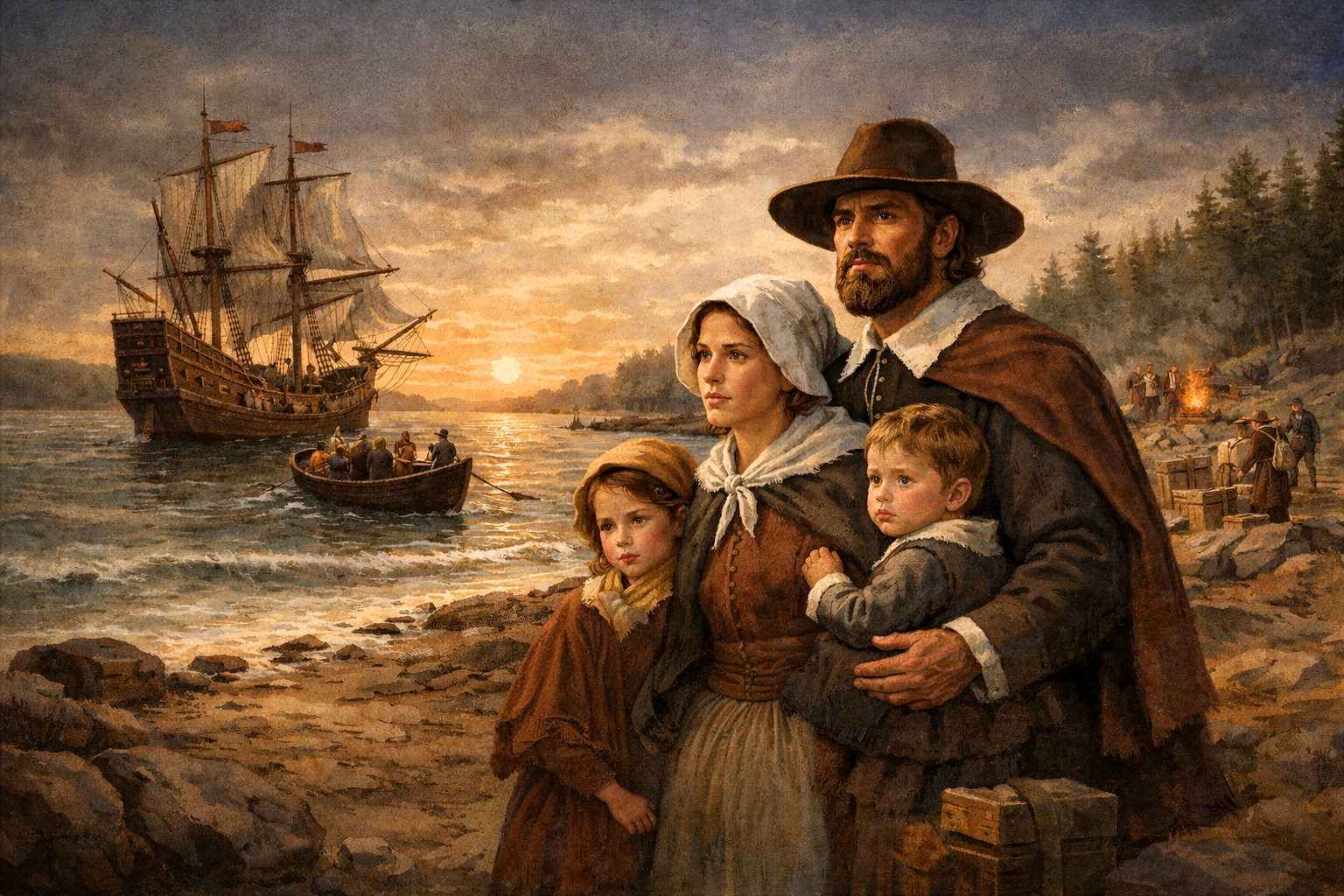
In 1630, William Rockwell, his wife Susan Capen, and their two young children crossed the Atlantic aboard the ship Mary and John as part of the Winthrop emigration. The voyage lasted about seventy days and ended with an unplanned landing at Nantasket Point. Within days, the family and their fellow passengers selected Dorchester as their place of settlement, beginning the first chapter of the Rockwell family’s life in New England.
In the spring of 1630, William Rockwell left England with his wife Susan Capen and their two small children aboard the ship Mary and John. They were not adventurers in search of fortune, nor soldiers of empire. They were members of a gathered church, already organized before departure, setting out together as a religious community bound for New England.
The Mary and John sailed as part of the Winthrop emigration, one of the most significant movements of people in early American history. She was a vessel of about four hundred tons, carrying approximately one hundred and forty passengers. The crossing took roughly seventy days. Throughout that long passage, religious life continued uninterrupted. According to contemporary accounts, sermons and expositions of Scripture were held daily for ten consecutive weeks. The voyage itself became an extension of the church.
William Rockwell was thirty-nine years old at the time. His wife Susan traveled with him, along with their children: a daughter, Joan, who turned five years old while still at sea, and a son, John, not yet three. The family carried with them not only their possessions but the responsibilities and expectations of adult life—parenthood, faith, and communal duty—into an uncertain world.
They sailed from Plymouth, England, on March 20, 1630. When the ship finally reached Massachusetts Bay, it did not proceed as planned. On Sunday, May 30, the Mary and John anchored near Nantasket Point. Despite prior assurances, the ship’s captain refused to navigate further that day, citing concerns about depth and unfamiliar channels. The passengers were put ashore on the Sabbath, against their wishes and contrary to their religious convictions.
Left without shelter or preparation, the settlers improvised. Boats were secured. Exploratory parties were sent inland. After several days of examination, they chose Mattapan—later called Dorchester—as the site of their settlement. By the end of the week, families and goods were ferried from Nantasket to their new home.
The first Sabbath in Dorchester was observed on June 6, 1630. The settlers rested from labor and gathered for worship, giving thanks for safe passage and for a place to dwell. A portion of the 90th Psalm was sung. It was the first Sabbath of a town that would soon become the largest and most influential settlement in early Massachusetts.
The conditions they encountered were severe. The settlers had arrived too late in the year to plant crops. Supplies from Salem were scarce. Shelter was makeshift. Hunger and illness followed quickly. For a time, many survived on clams, mussels, and fish gathered from the shore. Bread was rare. Meat was scarce. Families endured these hardships together, including those with young children like the Rockwells.
Relief eventually came. A ship sent by Governor Winthrop arrived with provisions from Ireland. Trade with local Native Americans supplied corn. Gradually, the immediate crisis eased, and the settlement began to stabilize.
For William Rockwell and his family, this crossing marked the beginning of seven years in Dorchester. During that time, he would become one of the two original deacons of the Dorchester church, sign early land grants, serve as a freeman of the colony, and participate in the civic and legal life of the new settlement. But all of that followed from this moment: a seventy-day voyage, a forced landing, and the decision to remain.
The crossing of the Mary and John was not simply a journey from England to New England. It was the transplantation of a community—its faith, governance, and family life—into a landscape that would test every one of those commitments.
Source: The Rockwell Family in One Line of Descent, Francis Williams Rockwell, with later additions, Chapter I (First American Generation).
📍 Historical Context & Related Content
Nantasket Point
Nantasket Point, located in present-day Hull, Massachusetts, was the unexpected landing site of the ship Mary and John on May 30, 1630. This location marked the beginning of the settlement of the Rockwell family and their fellow passengers in New England after an arduous transatlantic journey of about seventy days.Did you know? Nantasket Beach is one of the longest beaches in Massachusetts, notable for its unique glacially-formed sandy landscape. Today, it remains a popular seaside resort area.
Dorchester
Originally settled in June 1630 by the passengers of the Mary and John, Dorchester became one of the first towns established in the Massachusetts Bay Colony. It was named after the town of Dorchester in Dorset, England, and soon grew to be a leading settlement in the colony.Did you know? In 1633, Dorchester established the first school supported by public taxation in the United States, setting a precedent for public education in America.


Leave a Reply