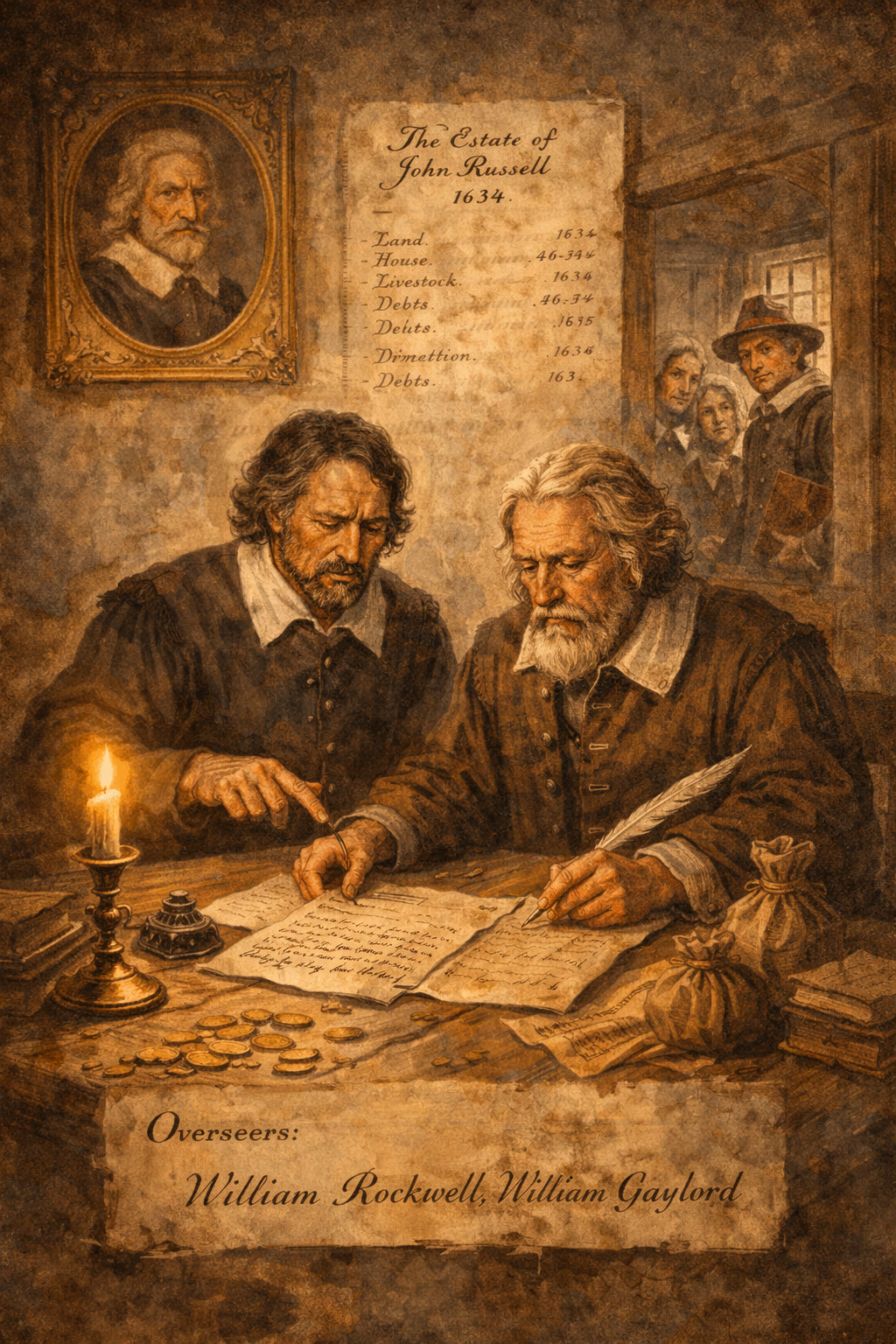
William Rockwell is identified as a deacon in the Dorchester, Massachusetts, church, a role described as managing the church’s material provisions and aid to those in need. The book connects that office to later exemptions from bearing arms and notes that gaps in Windsor and early Dorchester records make some details difficult to prove today.
The book treats William Rockwell’s deaconship as a practical office rather than a ceremonial title. Drawing on descriptions of the role, it frames the deacon’s work as receiving offerings and gifts, keeping the church treasury, and “serv[ing] the tables”—including provision for the Lord’s table, for ministers, and for “such as are in necessity,” to whom distributions were made “in simplicity.”
From that position, the book notes, Rockwell “was not called upon to bear arms.” It points to Windsor orders from 1638 requiring those above sixteen years old to bear arms, while exempting church officers and those who had filled such offices from “bearing arms, watchings and wardings.”
The book also flags an uncertainty: while Rockwell is described as a deacon in Dorchester, whether he held the same office after his removal to Windsor is “uncertain.” It notes that some Dorchester settlers went to Windsor in 1635 and 1636; the author states, “We think he did not go until the spring of 1637.” Rockwell died in 1640.
Why the uncertainty? Because early records are missing. The book explains that few Dorchester records were made during the first years after settlement beyond land grants and that in 1635–6, many early Dorchester settlers removed to Connecticut “taking with them the church records, which have not yet been found.” It adds that the first two leaves of Dorchester town records (four pages) are gone, that surviving Dorchester church records begin later, and that Windsor’s early town records and accounts for its first fifteen years “have crumbled to dust.”
Source: The Rockwell Family in One Line of Descent, discussion of deacons and the deacon’s duties (citing Mather’s Magnalia), the Windsor 1638 arms order and exemptions, and the explanation of missing/crumbled early Dorchester and Windsor records.
📍 Historical Context & Related Content
Dorchester, Massachusetts
Dorchester, Massachusetts, was one of the earliest settlements in the Massachusetts Bay Colony, founded in 1630. It was known for its early establishment of a church community, where William Rockwell served as a deacon. This role was crucial for managing the material provisions and administering aid within the congregation, which provided exemptions from certain civic duties like bearing arms.Did you know? Dorchester is considered the birthplace of the American public school system, having established the first public school supported by a public tax in 1639.
Related: William Rockwell’s Move to Windsor: A New Beginning. Tags: colonial America, Dorchester, church, William Rockwell. Categories: Colonial Settlements, Early Colonial America
Windsor, Connecticut
Windsor, Connecticut, is recognized as the first English settlement in the state, with settlers arriving as early as 1633. William Rockwell moved there in 1637, where uncertainties about his office—as records from both Dorchester and early Windsor have been lost—highlight the challenges of documentation in colonial America. He died in Windsor in 1640.Did you know? Windsor was originally named “Dorchester” by the settlers before they changed it to Windsor to avoid confusion with its Massachusetts counterpart.
Related: From England to New England: William Rockwell’s Legacy. Tags: colonial America, first generation, Windsor. Categories: American Colonies, Genealogy

Leave a Reply