by Nat Stevens
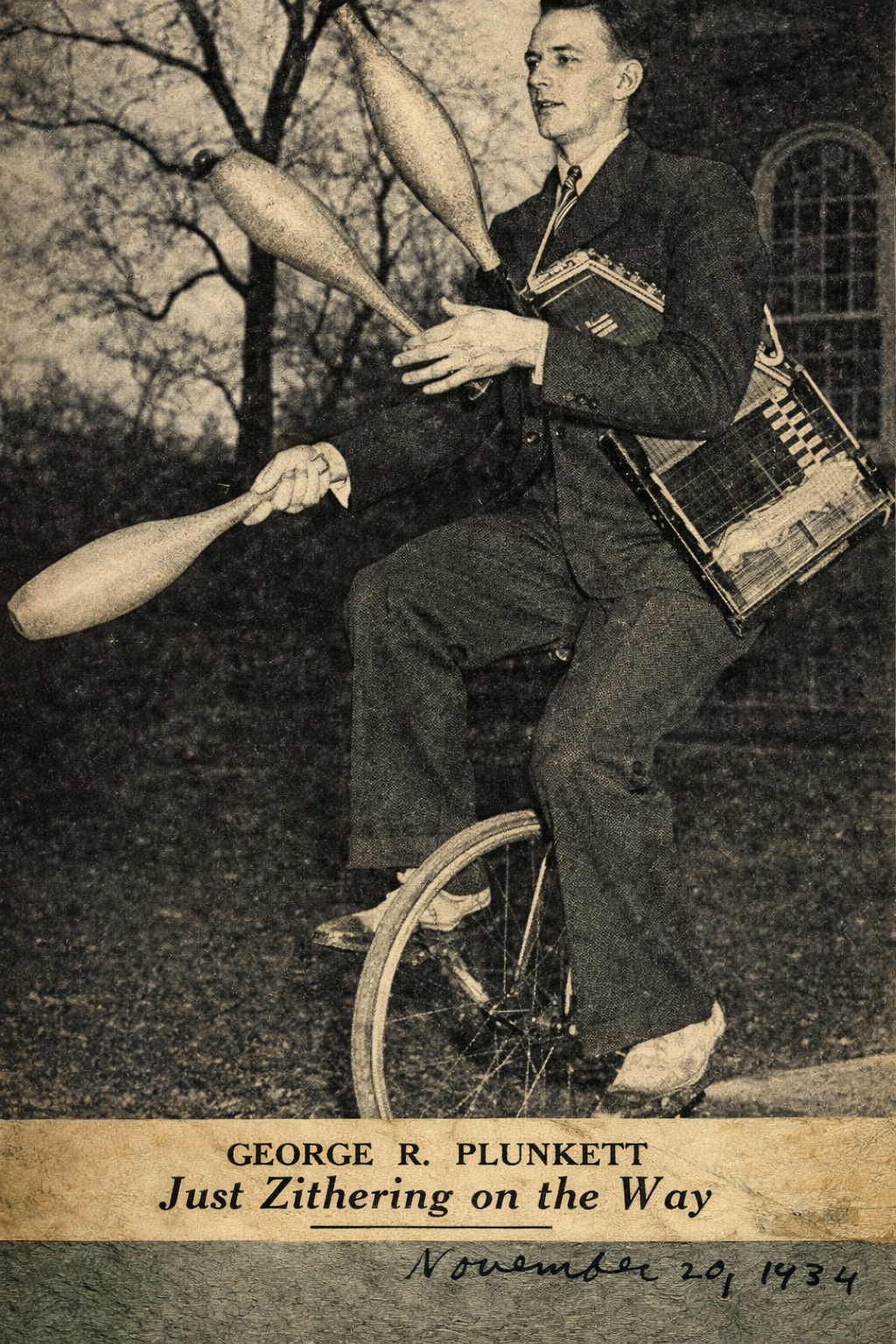
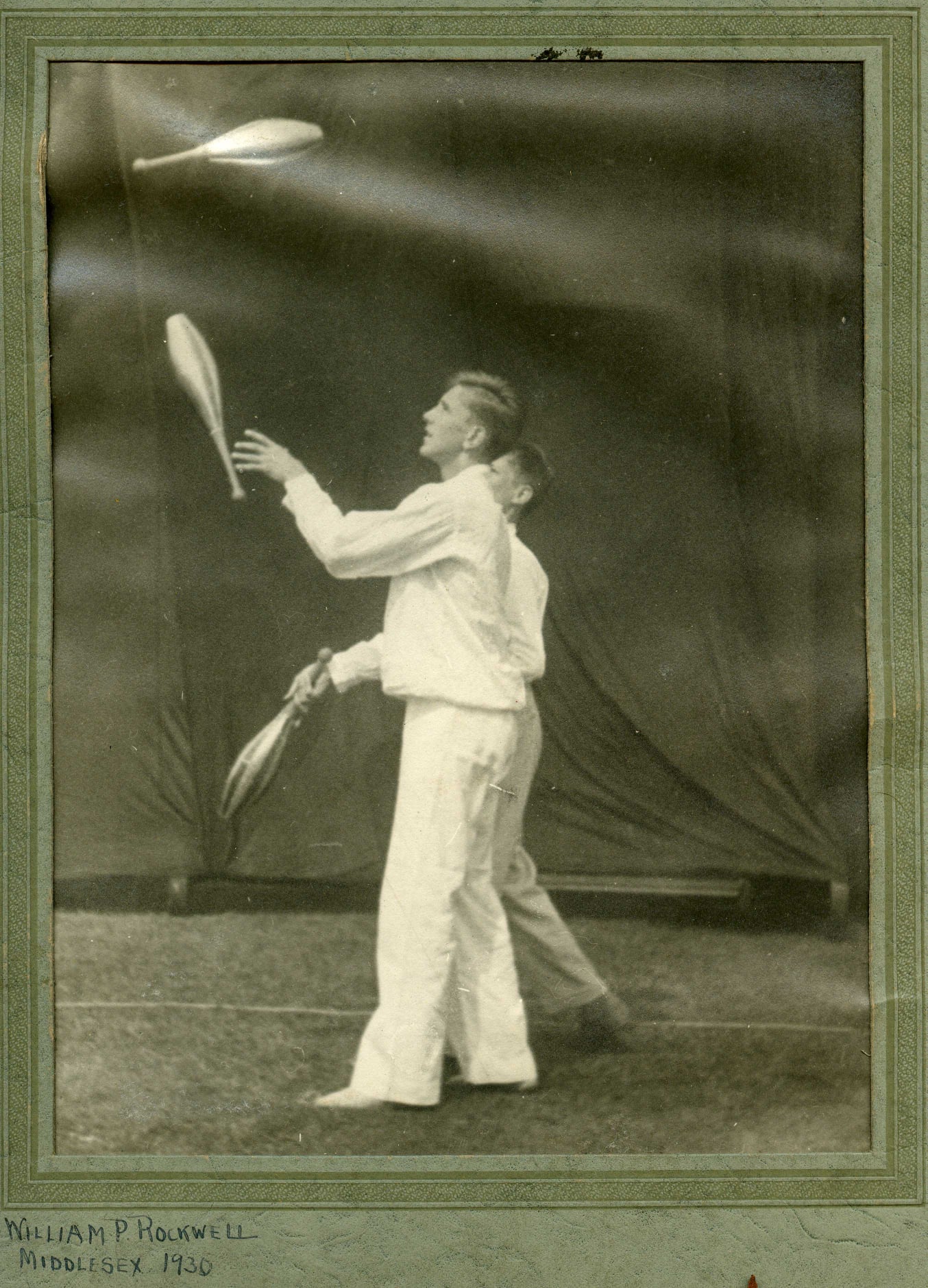
Hey Brad Rockwell, Tiffany Jesudian…It turns out that Uncle Bill Rockwell used an alias, George R Plunkett, when he rode his unicycle around Harvard so he wouldn’t get in trouble, and used his real name when he rode around the city of Cincinnati.
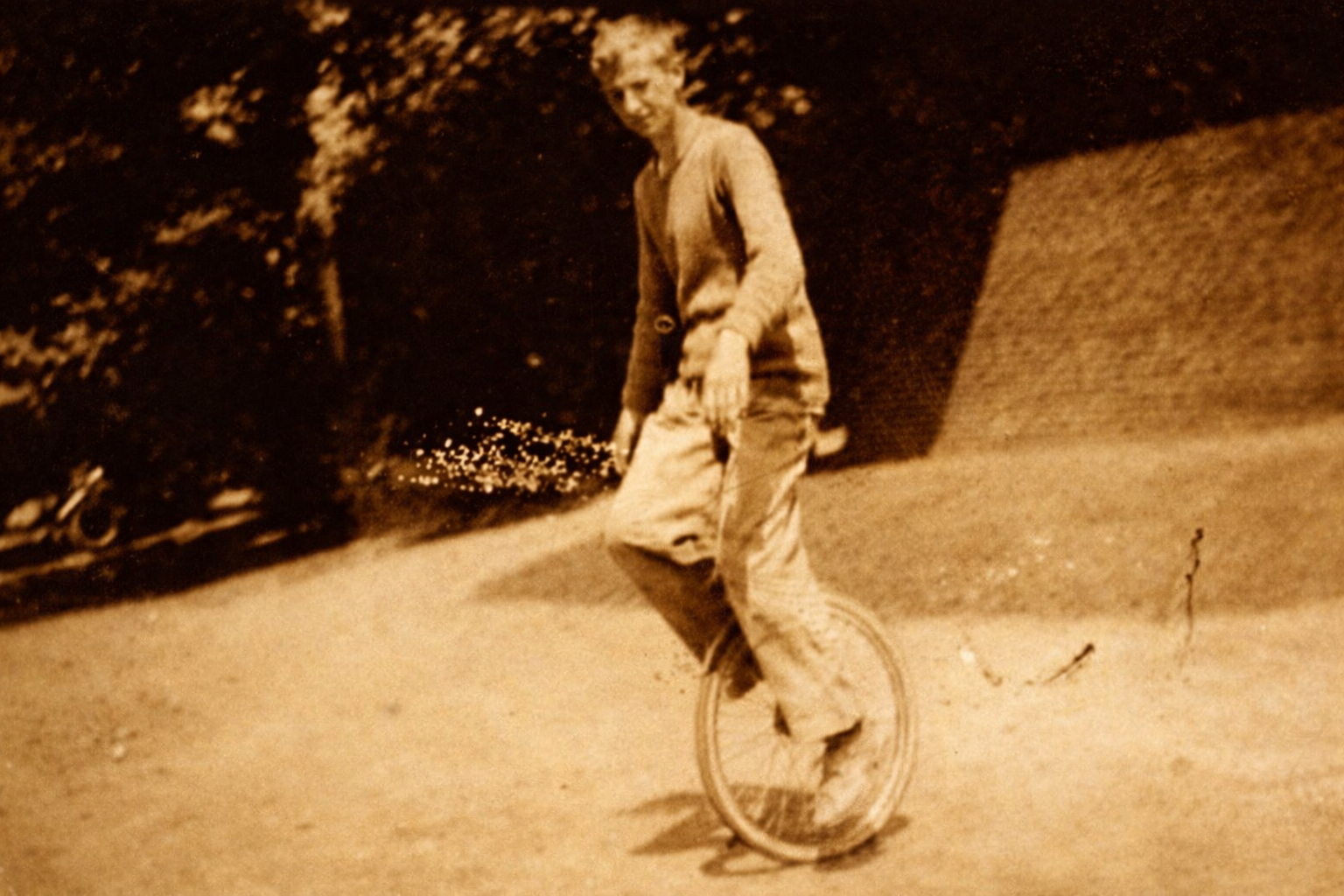
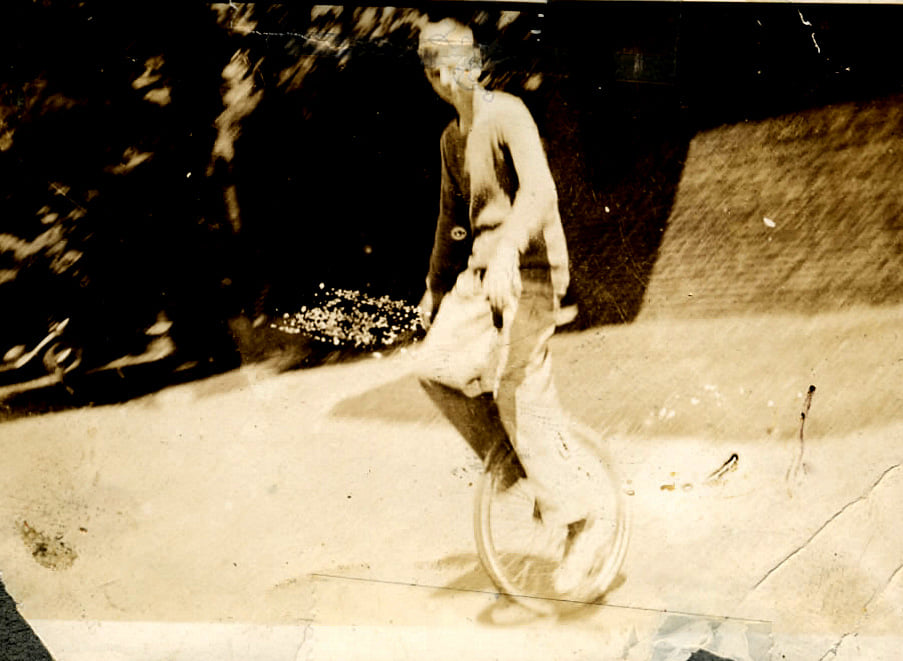
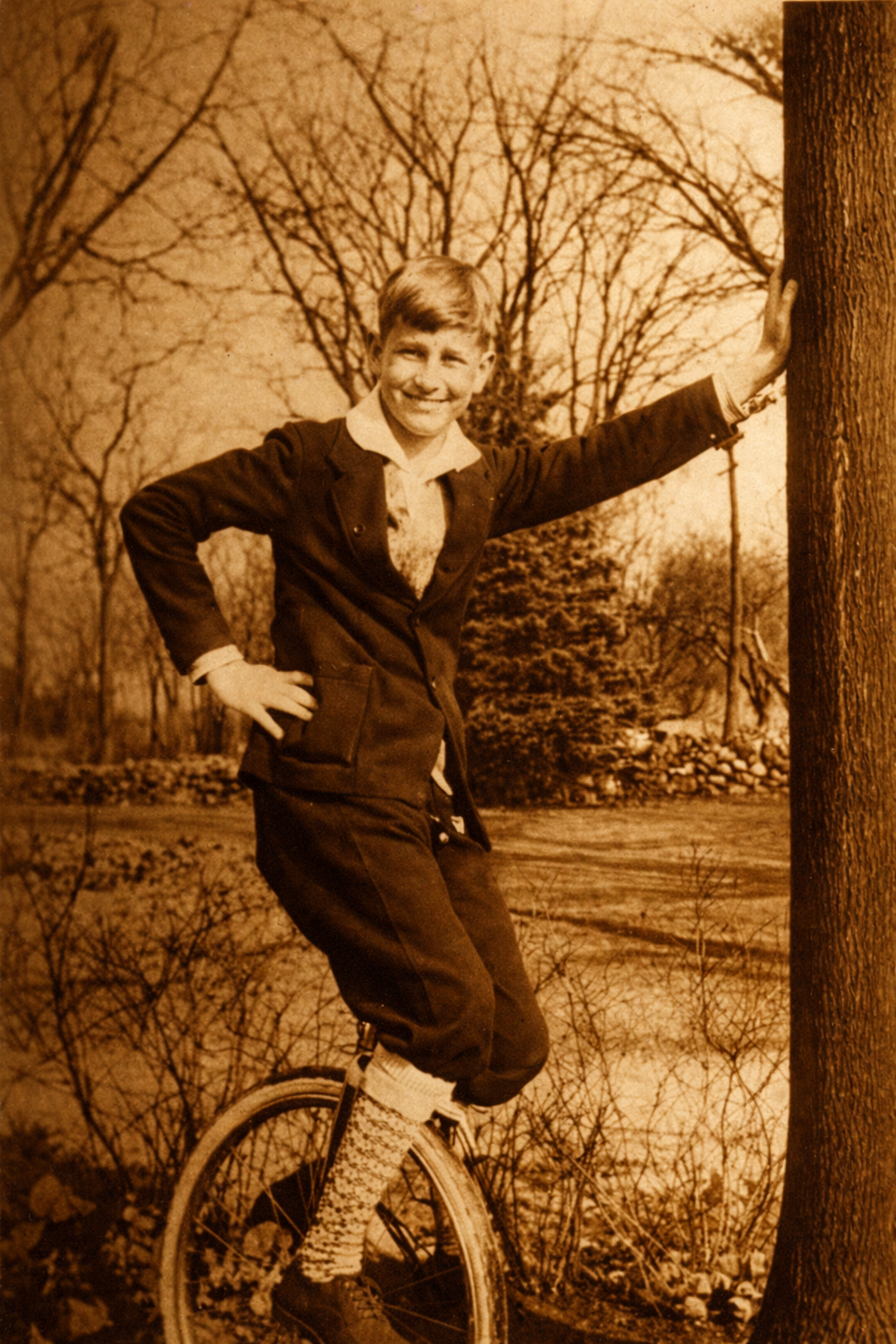

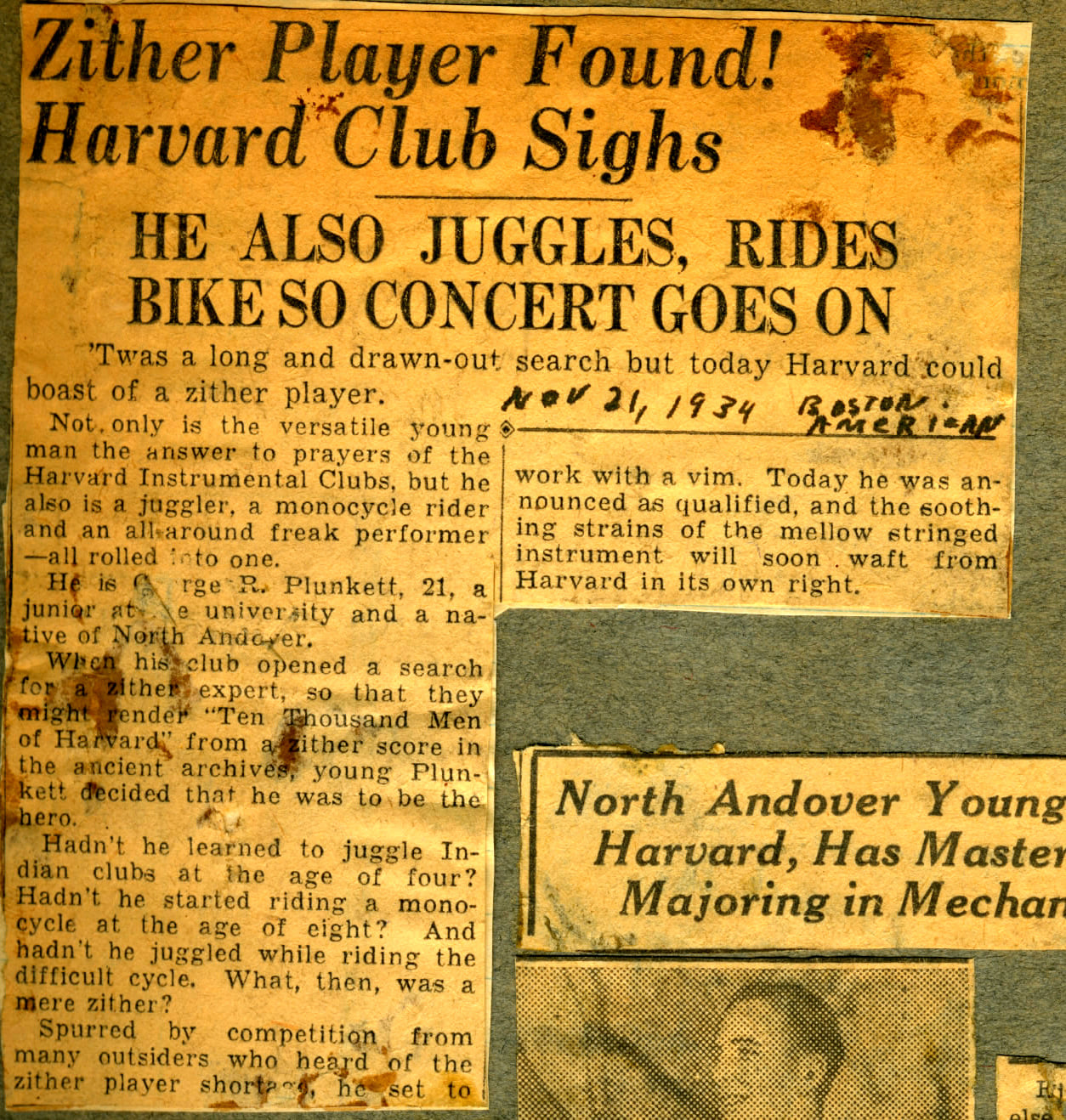
Title: Zither Player Found! Harvard Club Sighs
Source: Newspaper clipping
Date: 21 November 1934
Publication: Boston American (handwritten attribution)
Physical format: Newsprint clipping mounted on backing paper
Text (Diplomatic Transcription)
Zither Player Found!
Harvard Club Sighs
HE ALSO JUGGLES, RIDES
BIKE SO CONCERT GOES ON
“’Twas a long and drawn-out search but today Harvard could boast of a zither player.
Not only is the versatile young man the answer to prayers of the Harvard Instrumental Clubs, but he also is a juggler, a monocycle rider and an all-around freak performer — all rolled into one.
He is George R. Plunkett, 21, a junior at the university and a native of North Andover.
When his club opened a search for a zither expert so that they might render ‘Ten Thousand Men of Harvard’ from a zither score in the ancient archives, young Plunkett decided that he was to be the hero.
Hadn’t he learned to juggle Indian clubs at the age of four? Hadn’t he started riding a monocycle at the age of eight? And hadn’t he juggled while riding the difficult cycle. What, then, was a mere zither?
Spurred by competition from many outsiders who heard of the zither player shortage, he set to work with a vim. Today he was announced as qualified, and the soothing strains of the mellow stringed instrument will soon waft from Harvard in its own right.”
Handwritten Annotations
- Upper right margin, ink:
“Nov 21, 1934 Boston American”
Archival Transcription
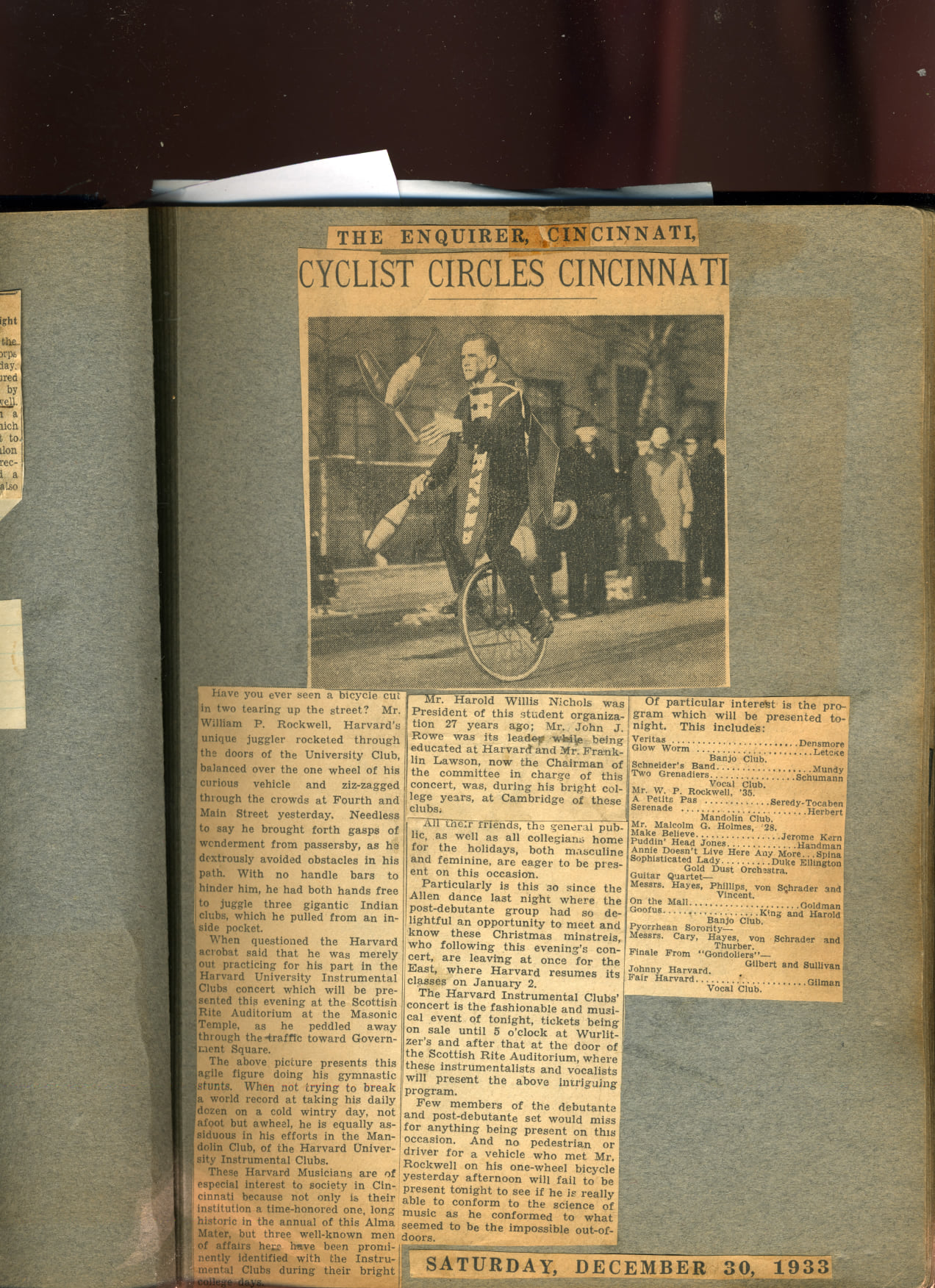
Title: Cyclist Circles Cincinnati
Source: Newspaper clipping
Publication: The Enquirer, Cincinnati
Date: Saturday, December 30, 1933
Physical format: Newsprint clipping mounted on scrapbook page
Masthead & Headline
THE ENQUIRER, CINCINNATI
CYCLIST CIRCLES CINCINNATI
Main Article Text
Have you ever seen a bicycle cut in two tearing up the street? Mr. William P. Rockwell, Harvard’s unique juggler, rocketed through the doors of the University Club, balanced over the one wheel of his curious vehicle and zig-zagged through the crowds at Fourth and Main Street yesterday. Needless to say he brought forth gasps of wonderment from passersby, as he dextrously avoided obstacles in his path. With no handle bars to hinder him, he had both hands free to juggle three gigantic Indian clubs, which he pulled from an inside pocket.
When questioned the Harvard acrobat said that he was merely out practicing for his part in the Harvard University Instrumental Clubs concert which will be presented this evening at the Scottish Rite Auditorium at the Masonic Temple, as he pedaled away through the traffic toward Government Square.
The above picture presents this agile figure doing his gymnastic stunts. When not trying to break a world record at taking his daily dozen on a cold wintry day, not afoot but a wheel, he is equally assiduous in his efforts in the Mandolin Club of the Harvard University Instrumental Clubs.
These Harvard musicians are of especial interest to society in Cincinnati because not only is their institution a time-honored one, long historic in the annals of this Alma Mater, but three well-known men of affairs here have been prominently identified with the Instrumental Clubs during their bright college careers.
Secondary Column (Center)
Mr. Harold Willis Nichols was president of this student organization 27 years ago; Mr. John J. Rowe was its leader while being educated at Harvard and Mr. Franklin Lawson, now the Chairman of the committee in charge of this concert, was, during his bright college years, at Cambridge of these clubs.
All Cincinnatians, the general public, as well as all collegians home for the holidays, both masculine and feminine, are eager to be present on this occasion.
Particularly is this so since the Allen dance last night where the post-debutante group had so delightful an opportunity to meet and know these Christmas minstrels, who following this evening’s concert, are leaving at once for the East, where Harvard resumes its classes on January 2.
The Harvard Instrumental Clubs’ concert is the fashionable musical event of tonight, tickets being on sale until 5 o’clock at Wurlitzer’s and after that at the door of the Scottish Rite Auditorium, where these instrumentalists and vocalists will present the above intriguing program.
Few members of the debutante and post-debutante set would miss for anything being present on this occasion. And no pedestrian or driver for a vehicle who met Mr. Rockwell on his one-wheel bicycle yesterday afternoon will fail to be present tonight to see if he is really able to conform to the science of music as he conformed to what seemed to be the impossible out-of-doors.
Program Listing (Right Column)
Of particular interest is the program which will be presented tonight. This includes:
Gavotte ………………………… Densmore
Glow Worm ………………………. Letzke
Schneider’s Banjo Club
Two Grenadiers …………… Schumann
Mr. W. P. Rockwell, ’35
A Petite Passee …………… Serenade Tocaben
Mandolin Club
Mr. Malcolm G. Holmes, ’28 …. Herbert
Make Believe ………………. Jerome Kern
Puddin’ Head Jones ………… Handman
Annie Doesn’t Live Here Any More …. Spina
Sophisticated Lady ………… Duke Ellington
Guitar Quartet
Messrs. Hayes, Phillips, von Schrader and Vincent
Goodfuss ………………….. Goldman
Pomphearn Sorority
Messrs. Cary, Hayes, von Schrader and Phillips
Finale: Gondoliers
Johnny Harvard ……………. Gilbert and Sullivan
Fair Harvard ………………. Gilman
Vocal Club
Date Line (Bottom)
SATURDAY, DECEMBER 30, 1933
Archival Transcription
Title (as printed, partially truncated):
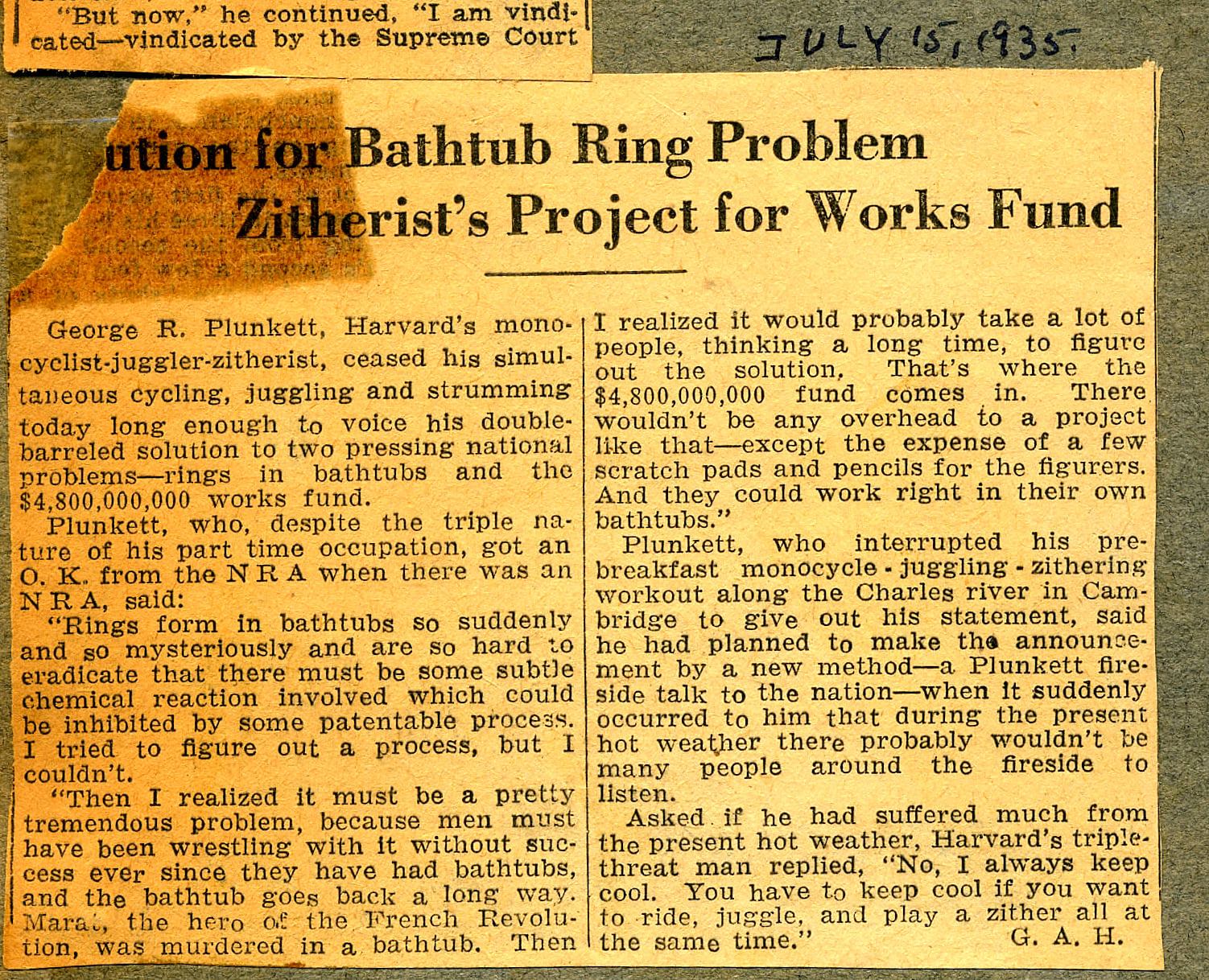
[—]ution for Bathtub Ring Problem
Zitherist’s Project for Works Fund
Date (handwritten): JULY 15, 1935
Source: Newspaper clipping (publication not identified in image)
Physical format: Newsprint clipping mounted on scrapbook backing
Text (Diplomatic Transcription)
George R. Plunkett, Harvard’s mono-cyclist-juggler-zitherist, ceased his simultaneous cycling, juggling and strumming today long enough to voice his double-barreled solution to two pressing national problems—rings in bathtubs and the $4,800,000,000 works fund.
Plunkett, who, despite the triple nature of his part time occupation, got an O.K. from the N R A when there was an N R A, said:
“Rings form in bathtubs so suddenly and so mysteriously and are so hard to eradicate that there must be some subtle chemical reaction involved which could be inhibited by some patentable process. I tried to figure out a process, but I couldn’t.
“Then I realized it must be a pretty tremendous problem, because men must have been wrestling with it without success ever since they have had bathtubs, and the bathtub goes back a long way. Marat, the hero of the French Revolution, was murdered in a bathtub. Then I realized it would probably take a lot of people, thinking a long time, to figure out the solution. That’s where the $4,800,000,000 fund comes in. There wouldn’t be any overhead to a project like that—except the expense of a few scratch pads and pencils for the figurers. And they could work right in their own bathtubs.”
Plunkett, who interrupted his pre-breakfast monocycle-juggling-zithering workout along the Charles river in Cambridge to give out his statement, said he had planned to make the announcement by a new method—a Plunkett fireside talk to the nation—when it suddenly occurred to him that during the present hot weather there probably wouldn’t be many people around the fireside to listen.
Asked if he had suffered much from the present hot weather, Harvard’s triple-threat man replied, “No, I always keep cool. You have to keep cool if you want to ride, juggle, and play a zither all at the same time.”
G. A. H.
Handwritten Annotations
- Upper right margin, ink:
“JULY 15, 1935.”
Archival Transcription
Title:
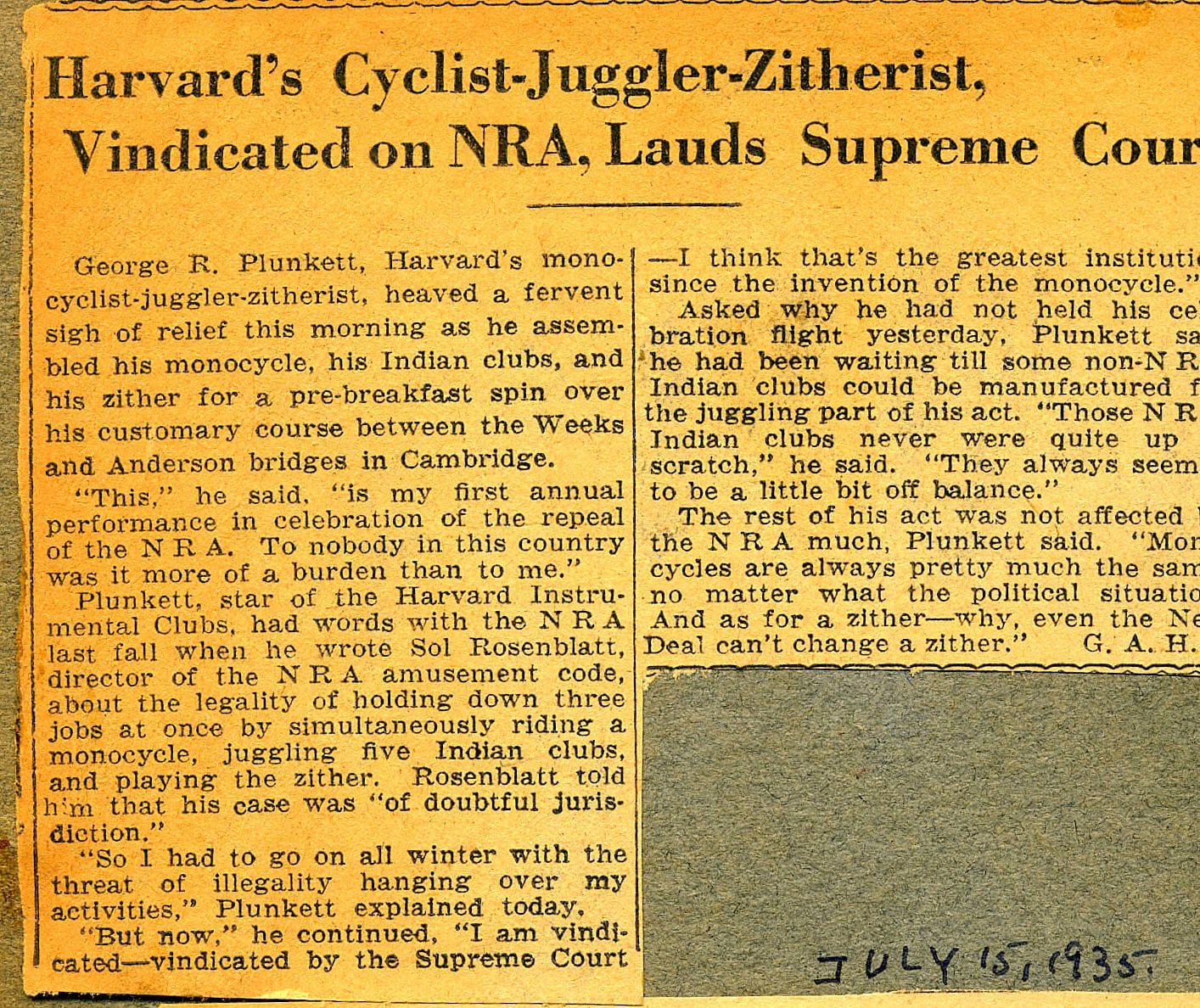
Harvard’s Cyclist-Juggler-Zitherist,
Vindicated on NRA, Lauds Supreme Court
Date (handwritten): JULY 15, 1935
Source: Newspaper clipping (publication not identified in image)
Physical format: Newsprint clipping mounted on scrapbook backing
Text (Diplomatic Transcription)
George R. Plunkett, Harvard’s mono-cyclist-juggler-zitherist, heaved a fervent sigh of relief this morning as he assembled his monocycle, his Indian clubs, and his zither for a pre-breakfast spin over his customary course between the Weeks and Anderson bridges in Cambridge.
“This,” he said, “is my first annual performance in celebration of the repeal of the N R A. To nobody in this country was it more of a burden than to me.”
Plunkett, star of the Harvard Instrumental Clubs, had words with the N R A last fall when he wrote Sol Rosenblatt, director of the N R A amusement code, about the legality of holding down three jobs at once by simultaneously riding a monocycle, juggling five Indian clubs, and playing the zither. Rosenblatt told him that his case was “of doubtful jurisdiction.”
“So I had to go on all winter with the threat of illegality hanging over my activities,” Plunkett explained today.
“But now,” he continued, “I am vindicated—vindicated by the Supreme Court—I think that’s the greatest institution since the invention of the monocycle.”
Asked why he had not held his celebration flight yesterday, Plunkett said he had been waiting till some non-N R A Indian clubs could be manufactured for the juggling part of his act. “Those N R A Indian clubs never were quite up to scratch,” he said. “They always seem to be a little bit off balance.”
The rest of his act was not affected by the N R A much, Plunkett said. “Monocycles are always pretty much the same, no matter what the political situation. And as for a zither—why, even the New Deal can’t change a zither.”
G. A. H.
Handwritten Annotations
- Lower right margin, ink:
“JULY 15, 1935.”
Archival Transcription
Title:
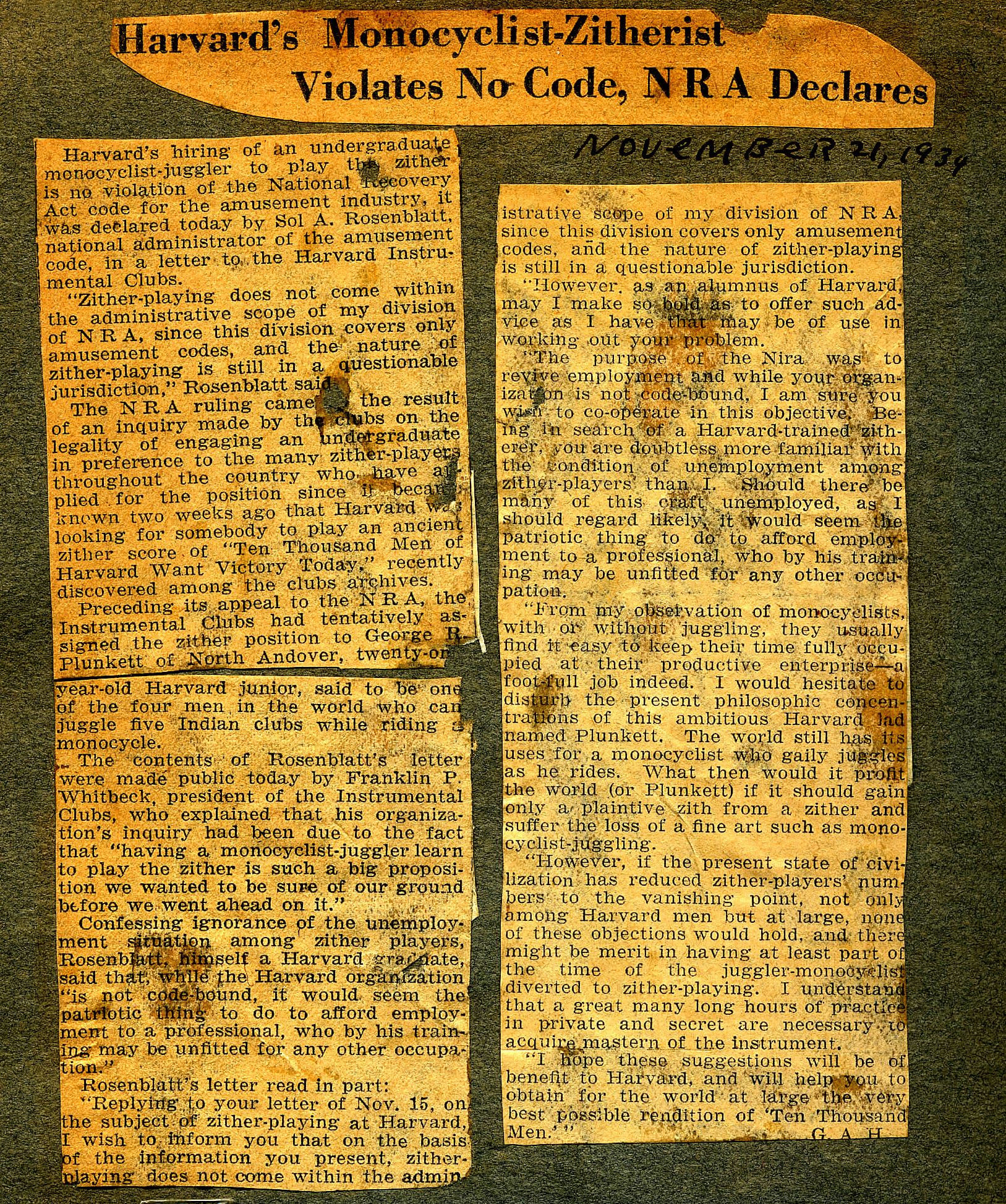
Harvard’s Monocyclist-Zitherist
Violates No Code, NRA Declares
Date (handwritten): NOVEMBER 21, 1934
Source: Newspaper clipping (publication not identified in image)
Physical format: Newsprint clipping mounted on scrapbook backing
Text (Diplomatic Transcription)
Harvard’s hiring of an undergraduate monocyclist-juggler to play the zither is no violation of the National Recovery Act code for the amusement industry, it was declared today by Sol A. Rosenblatt, national administrator of the amusement code, in a letter to the Harvard Instrumental Clubs.
“Zither-playing does not come within the administrative scope of my division of N R A, since this division covers only amusement codes, and the nature of zither-playing is still in a questionable jurisdiction,” Rosenblatt said.
The N R A ruling came as the result of an inquiry made by the clubs on the legality of engaging an undergraduate in preference to the many zither-players throughout the country who have applied for the position since it became known two weeks ago that Harvard was looking for somebody to play an ancient zither score of “Ten Thousand Men of Harvard Want Victory Today,” recently discovered among the clubs’ archives.
Preceding its appeal to the N R A, the Instrumental Clubs had tentatively assigned the zither position to George R. Plunkett of North Andover, twenty-one-year-old Harvard junior, said to be one of the four men in the world who can juggle five Indian clubs while riding a monocycle.
The contents of Rosenblatt’s letter were made public today by Franklin P. Whitbeck, president of the Instrumental Clubs, who explained that his organization’s inquiry had been due to the fact that “having a monocyclist-juggler learn to play the zither is such a big proposition we wanted to be sure of our ground before we went ahead on it.”
Confessing ignorance of the unemployment situation among zither players, Rosenblatt, himself a Harvard graduate, said that, “while the Harvard organization is not code-bound, it would seem the patriotic thing to do to afford employment to a professional, who by his training may be unfitted for any other occupation.”
Rosenblatt’s letter read in part:
“Replying to your letter of Nov. 15, on the subject of zither-playing at Harvard, I wish to inform you that on the basis of the information you present, zither-playing does not come within the administrative scope of my division of N R A, since this division covers only amusement codes, and the nature of zither-playing is still in a questionable jurisdiction.
“However, as an alumnus of Harvard, may I make so bold as to offer such advice as I have that may be of use in working out your problem.
“The purpose of the N R A was to revive employment and while your organization is not code-bound, I am sure you will wish to co-operate in this objective. Being in search of a Harvard-trained zitherist, you are doubtless more familiar with the condition of unemployment among zither-players than I. Should there be many of this craft unemployed, as I should regard likely, it would seem the patriotic thing to do to afford employment to a professional who by his training may be unfitted for any other occupation.
“From my observation of monocyclists, with or without juggling, they usually find it easy to keep their time fully occupied at their productive enterprise—a foot-full job indeed. I would hesitate to disturb the present philosophic concentrations of this ambitious Harvard lad named Plunkett. The world still has its uses for a monocyclist who gaily juggles as he rides. What then would it profit the world (or Plunkett) if it should gain only a plaintive zith from a zither and suffer the loss of a fine art such as monocycle-juggling.
“However, if the present state of civilization has reduced zither-players’ numbers to the vanishing point, not only among Harvard men but at large, none of these objections would hold, and there might be merit in having at least part of the time of the juggler-monocyclist diverted to zither-playing. I understand that a great many long hours of practice in private and secret are necessary to acquire mastery of the instrument.
“I hope these suggestions will be of benefit to Harvard and will help you to obtain for the world at large the very best possible rendition of ‘Ten Thousand Men.’”
G. A. H.
Handwritten Annotations
- Upper right margin, ink:
“NOVEMBER 21, 1934”
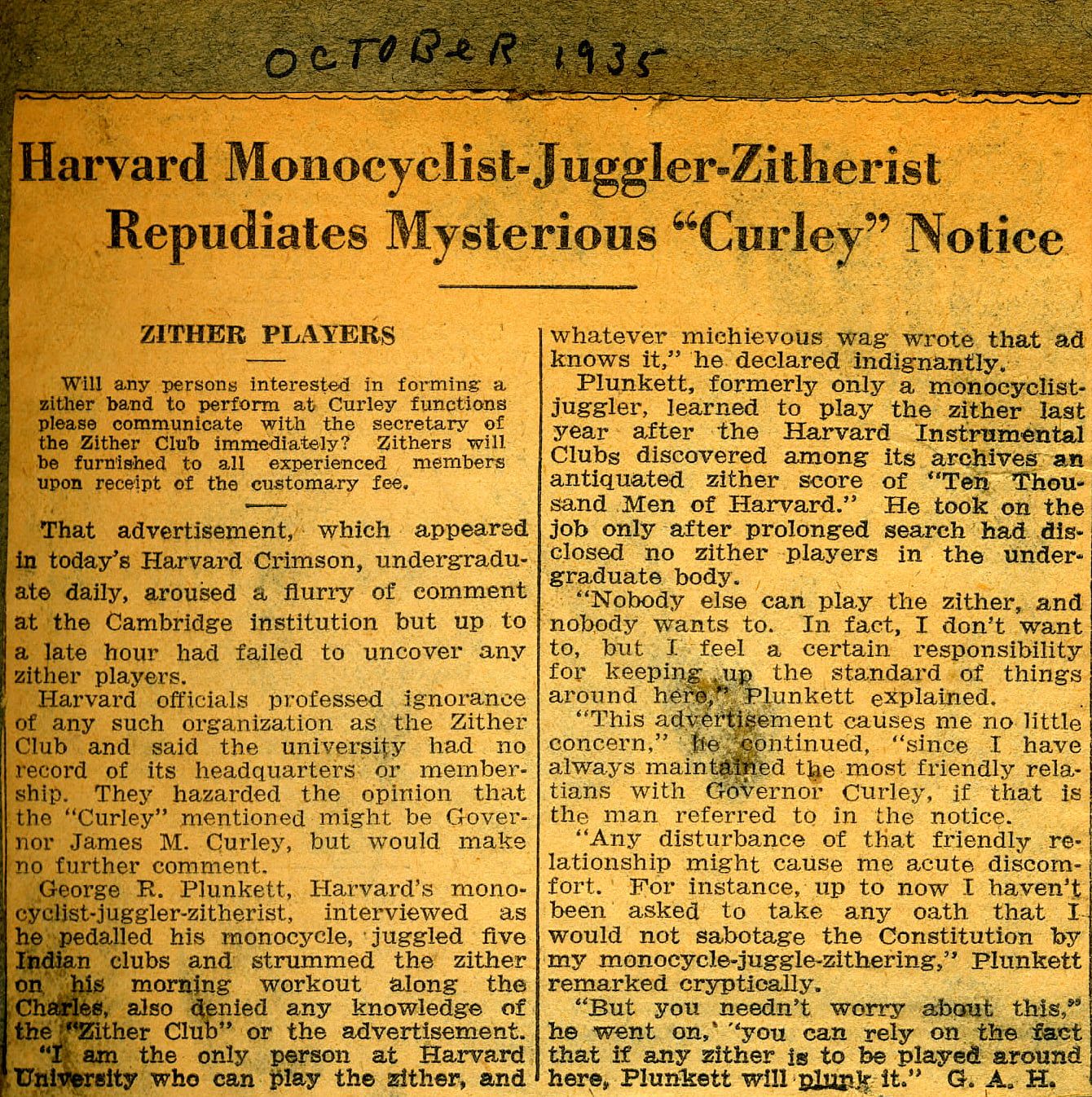
Archival Transcription
Title:
Harvard Monocyclist-Juggler-Zitherist
Repudiates Mysterious “Curley” Notice
Date (handwritten, upper margin): OCTOBER 1935
Source: Newspaper clipping (publication not identified in image)
Physical format: Newsprint clipping mounted on scrapbook backing
Subheading / Notice (as printed)
ZITHER PLAYERS
Will any persons interested in forming a zither band to perform at Curley functions please communicate with the secretary of the Zither Club immediately? Zithers will be furnished to all experienced members upon receipt of the customary fee.
Main Text (Diplomatic Transcription)
That advertisement, which appeared in today’s Harvard Crimson, undergraduate daily, aroused a flurry of comment at the Cambridge institution but up to a late hour had failed to uncover any zither players.
Harvard officials professed ignorance of any such organization as the Zither Club and said the university had no record of its headquarters or membership. They hazarded the opinion that the “Curley” mentioned might be Governor James M. Curley, but would make no further comment.
George R. Plunkett, Harvard’s monocyclist-juggler-zitherist, interviewed as he pedalled his monocycle, juggled five Indian clubs and strummed the zither on his morning workout along the Charles, also denied any knowledge of the “Zither Club” or the advertisement.
“I am the only person at Harvard University who can play the zither, and whatever mischievous wag wrote that ad knows it,” he declared indignantly.
Plunkett, formerly only a monocyclist-juggler, learned to play the zither last year after the Harvard Instrumental Clubs discovered among its archives an antiquated zither score of “Ten Thousand Men of Harvard.” He took on the job only after prolonged search had disclosed no zither players in the undergraduate body.
“Nobody else can play the zither, and nobody wants to. In fact, I don’t want to, but I feel a certain responsibility for keeping up the standard of things around here,” Plunkett explained.
“This advertisement causes me no little concern,” he continued, “since I have always maintained the most friendly relations with Governor Curley, if that is the man referred to in the notice.
“Any disturbance of that friendly relationship might cause me acute discomfort. For instance, up to now I haven’t been asked to take any oath that I would not sabotage the Constitution by my monocycle-juggle-zithering,” Plunkett remarked cryptically.
“But you needn’t worry about this,” he went on; “you can rely on the fact that if any zither is to be played around here, Plunkett will plunk it.”
G. A. H.
Handwritten Annotations
- Upper margin, ink:
“OCTOBER 1935”
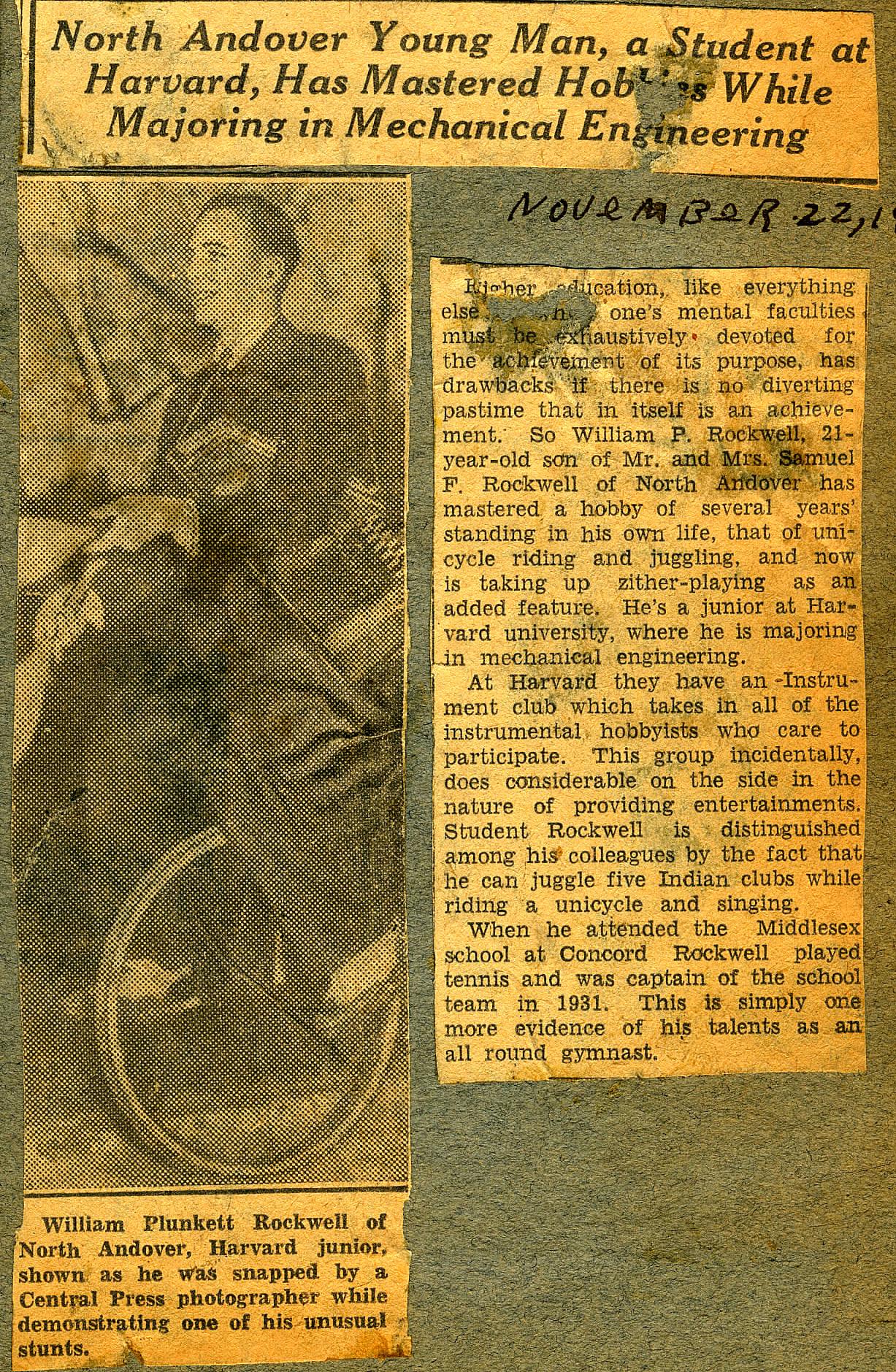
Archival Transcription
Title:
North Andover Young Man, a Student at Harvard, Has Mastered Hobbies While Majoring in Mechanical Engineering
Date (handwritten, upper right): NOVEMBER 22, 19[—]
(final digits not fully legible in the image)
Source: Newspaper clipping (publication not identified in image)
Physical format: Newsprint clipping mounted on scrapbook backing
Main Text (Diplomatic Transcription)
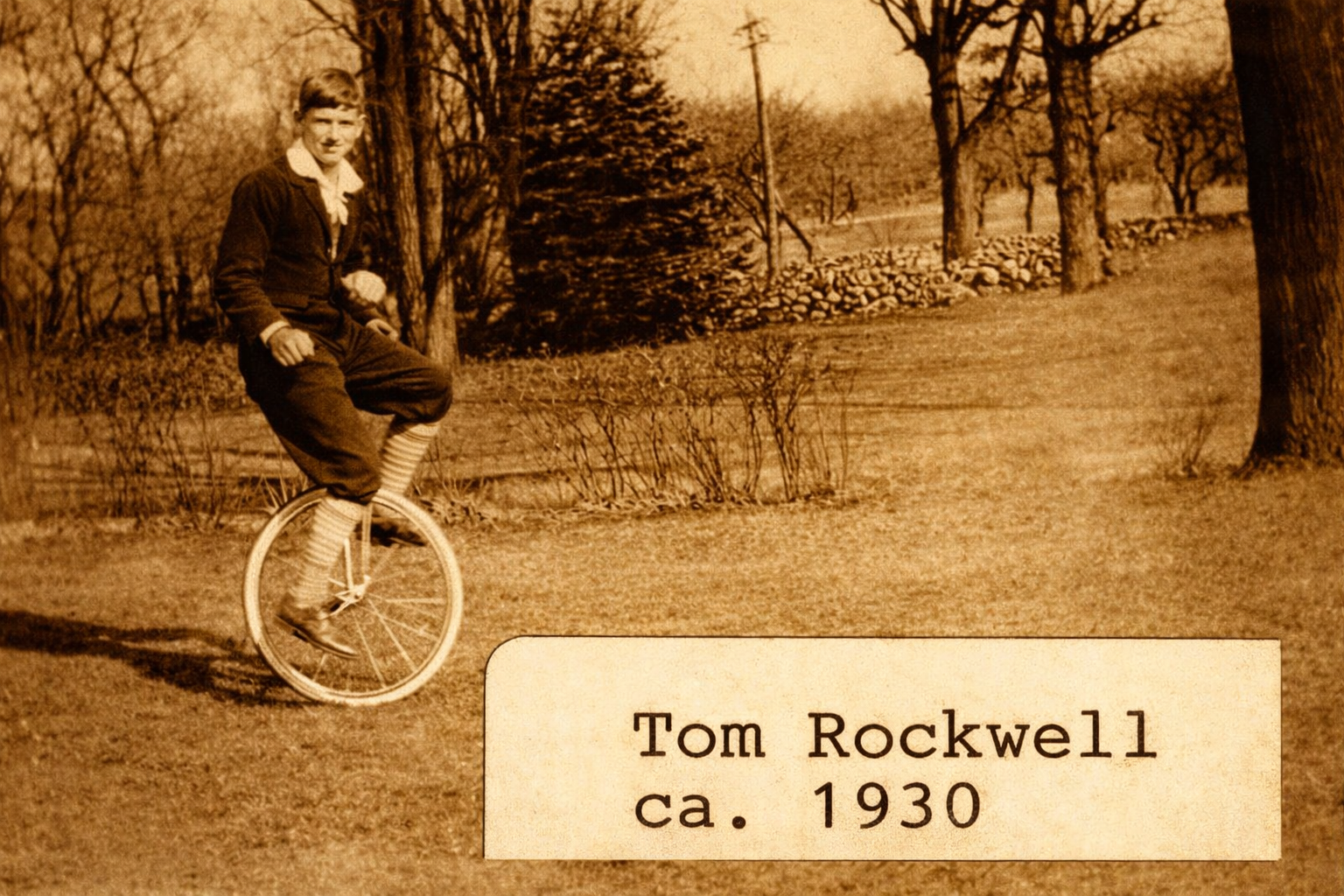
Higher education, like everything else that one’s mental faculties must be exhaustively devoted for the achievement of its purpose, has drawbacks if there is no diverting pastime that in itself is an achievement. So William P. Rockwell, 21-year-old son of Mr. and Mrs. Samuel F. Rockwell of North Andover has mastered a hobby of several years’ standing in his own life, that of unicycle riding and juggling, and now is taking up zither-playing as an added feature. He’s a junior at Harvard university, where he is majoring in mechanical engineering.
At Harvard they have an Instrument club which takes in all of the instrumental hobbyists who care to participate. This group incidentally does considerable on the side in the nature of providing entertainments. Student Rockwell is distinguished among his colleagues by the fact that he can juggle five Indian clubs while riding a unicycle and singing.
When he attended the Middlesex school at Concord Rockwell played tennis and was captain of the school team in 1931. This is simply one more evidence of his talents as an all round gymnast.
Caption (Beneath Photograph)
William Plunkett Rockwell of North Andover, Harvard junior, shown as he was snapped by a Central Press photographer while demonstrating one of his unusual stunts.
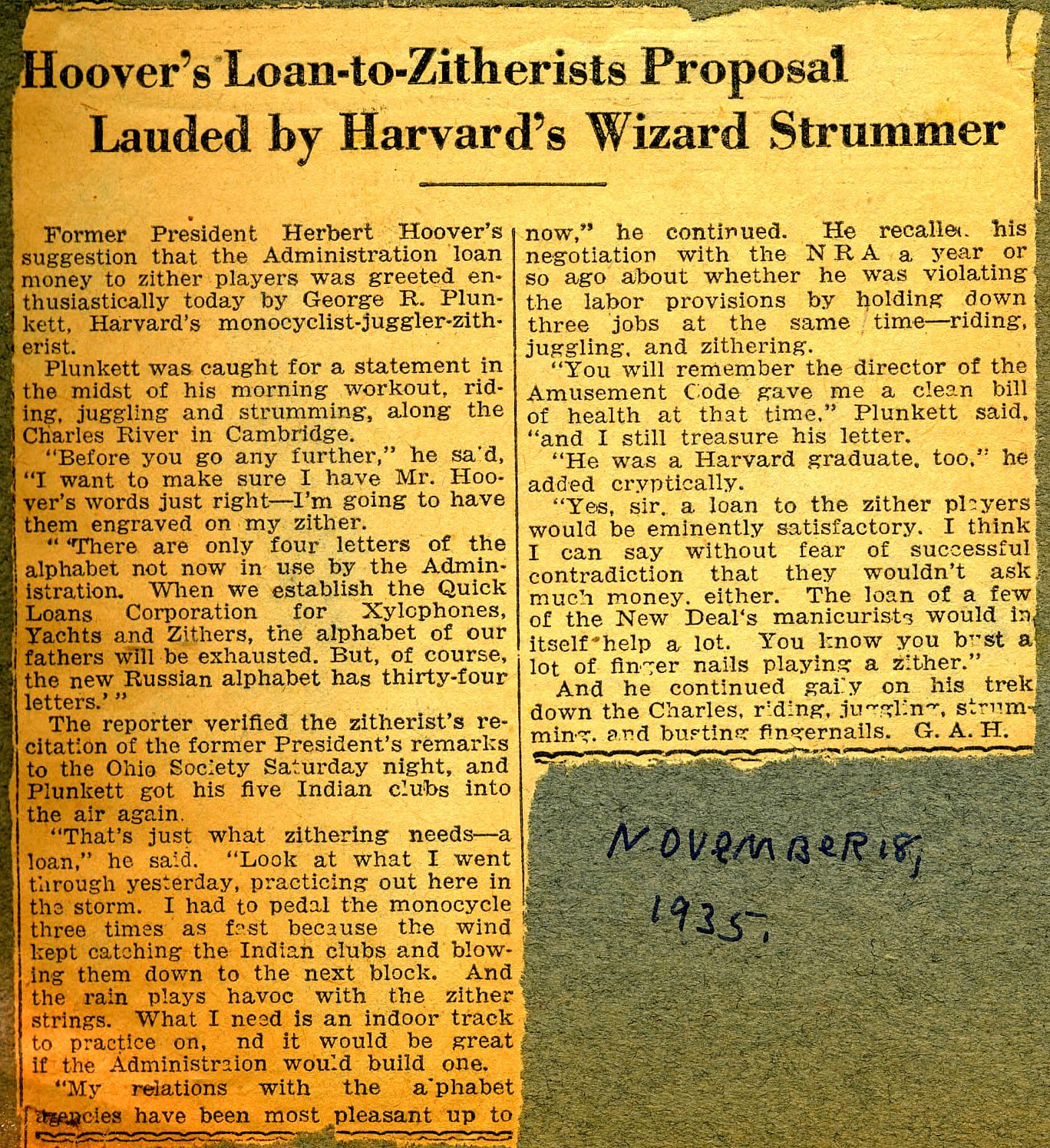
Archival Transcription
Title:
Hoover’s Loan-to-Zitherists Proposal
Lauded by Harvard’s Wizard Strummer
Date (handwritten, lower right): NOVEMBER 18, 1935
Source: Newspaper clipping (publication not identified in image)
Physical format: Newsprint clipping mounted on scrapbook backing
Text (Diplomatic Transcription)
Former President Herbert Hoover’s suggestion that the Administration loan money to zither players was greeted enthusiastically today by George R. Plunkett, Harvard’s monocyclist-juggler-zitherist.
Plunkett was caught for a statement in the midst of his morning workout, riding, juggling and strumming, along the Charles River in Cambridge.
“Before you go any further,” he said, “I want to make sure I have Mr. Hoover’s words just right—I’m going to have them engraved on my zither.
“There are only four letters of the alphabet not now in use by the Administration. When we establish the Quick Loans Corporation for Xylophones, Yachts and Zithers, the alphabet of our fathers will be exhausted. But, of course, the new Russian alphabet has thirty-four letters.”
The reporter verified the zitherist’s recitation of the former President’s remarks to the Ohio Society Saturday night, and Plunkett got his five Indian clubs into the air again.
“That’s just what zithering needs—a loan,” he said. “Look at what I went through yesterday, practicing out here in the storm. I had to pedal the monocycle three times as fast because the wind kept catching the Indian clubs and blowing them down to the next block. And the rain plays havoc with the zither strings. What I need is an indoor track to practice on, and it would be great if the Administration would build one.
“My relations with the alphabet agencies have been most pleasant up to now,” he continued. He recalled his negotiation with the N R A a year or so ago about whether he was violating the labor provisions by holding down three jobs at the same time—riding, juggling, and zithering.
“You will remember the director of the amusement code gave me a clean bill of health at that time,” Plunkett said, “and I still treasure his letter.
“He was a Harvard graduate, too,” he added cryptically.
“Yes, sir, a loan to the zither players would be eminently satisfactory. I think I can say without fear of successful contradiction that they wouldn’t ask much money, either. The loan of a few of the New Deal’s manicurists would in itself help a lot. You know you bust a lot of finger nails playing a zither.”
And he continued gaily on his trek down the Charles, riding, juggling, strumming, and bursting fingernails.
G. A. H.
Handwritten Annotations
- Lower right margin, ink:
“NOVEMBER 18, 1935”


Leave a Reply