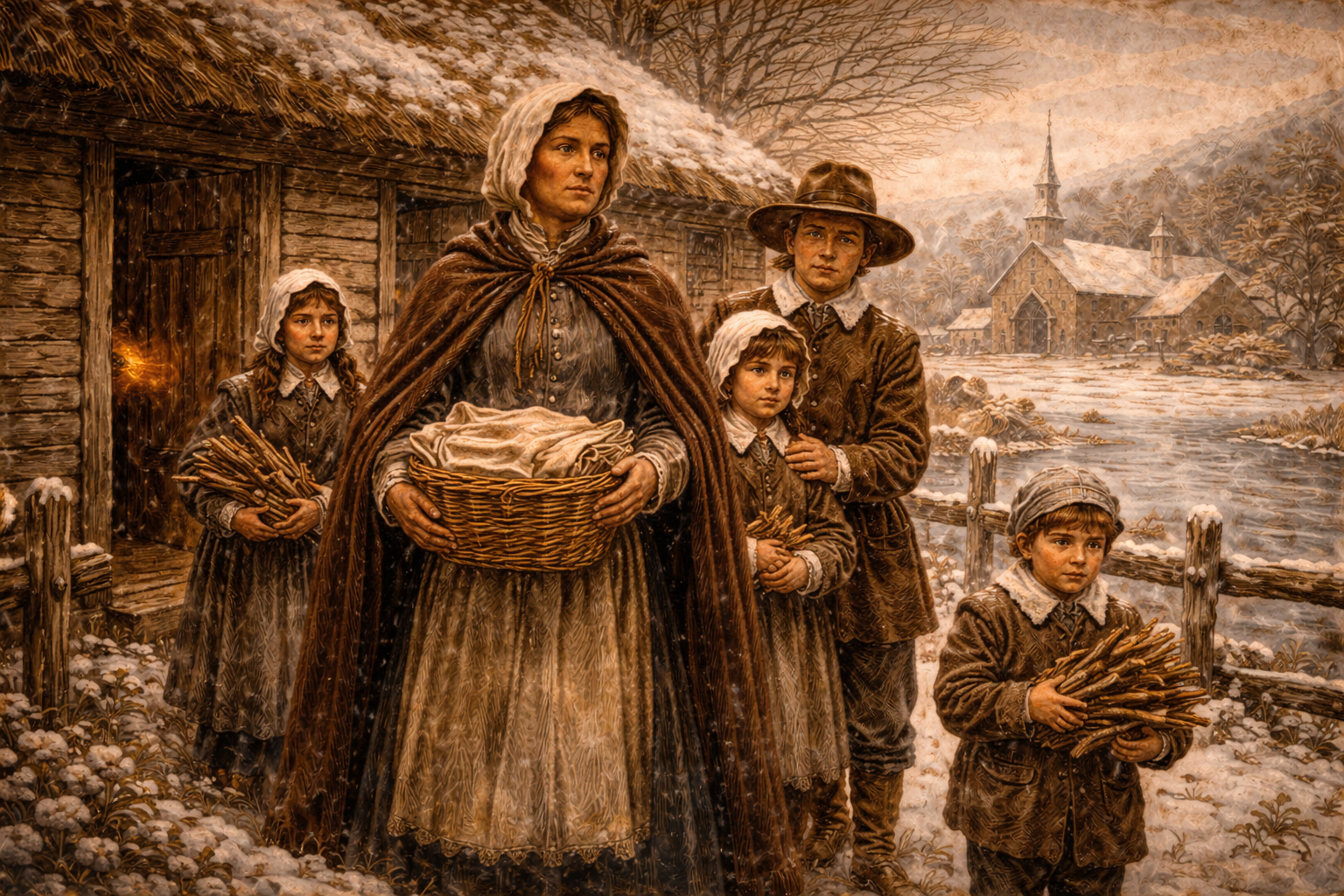
After the death of her husband in 1640, Susan Capen Rockwell survived as a widow in Connecticut. The book treats her role as essential to the continuity of the Rockwell family through its second generation, though surviving records preserve only limited detail.
Susan Capen Rockwell had crossed the Atlantic with her husband and young children in 1630, enduring the earliest hardships of settlement in Dorchester. By 1640, she found herself a widow in Windsor, responsible for maintaining her household and guiding her children into adulthood.
The book does not provide extensive detail about Susan Rockwell’s later life, reflecting the broader pattern of early colonial records, which tend to preserve fewer details about women beyond marriage, widowhood, and family connections.
Despite this scarcity, her importance is implicit. She represented continuity at a moment of transition, carrying the family from its first generation into the second. Through her survival, the Rockwell children remained rooted in the colony rather than returning to England or dispersing.
The book treats Susan Capen Rockwell not as a public figure but as a stabilizing presence whose life bridged migration, settlement, loss, and persistence—an experience shared by many women of the founding generation.
Source: The Rockwell Family in One Line of Descent, discussion of William Rockwell’s death and references to Susan Capen Rockwell as surviving widow and mother of the second generation.

Leave a Reply