Rockwell, Samuel Forbes. Davis Families of Early Roxbury and Boston. North Andover, Mass., 1932.
I have reconstructed the narrative of this historical mix-up, which serves as a prime example of why we must always cross-reference historical anecdotes with vital records.
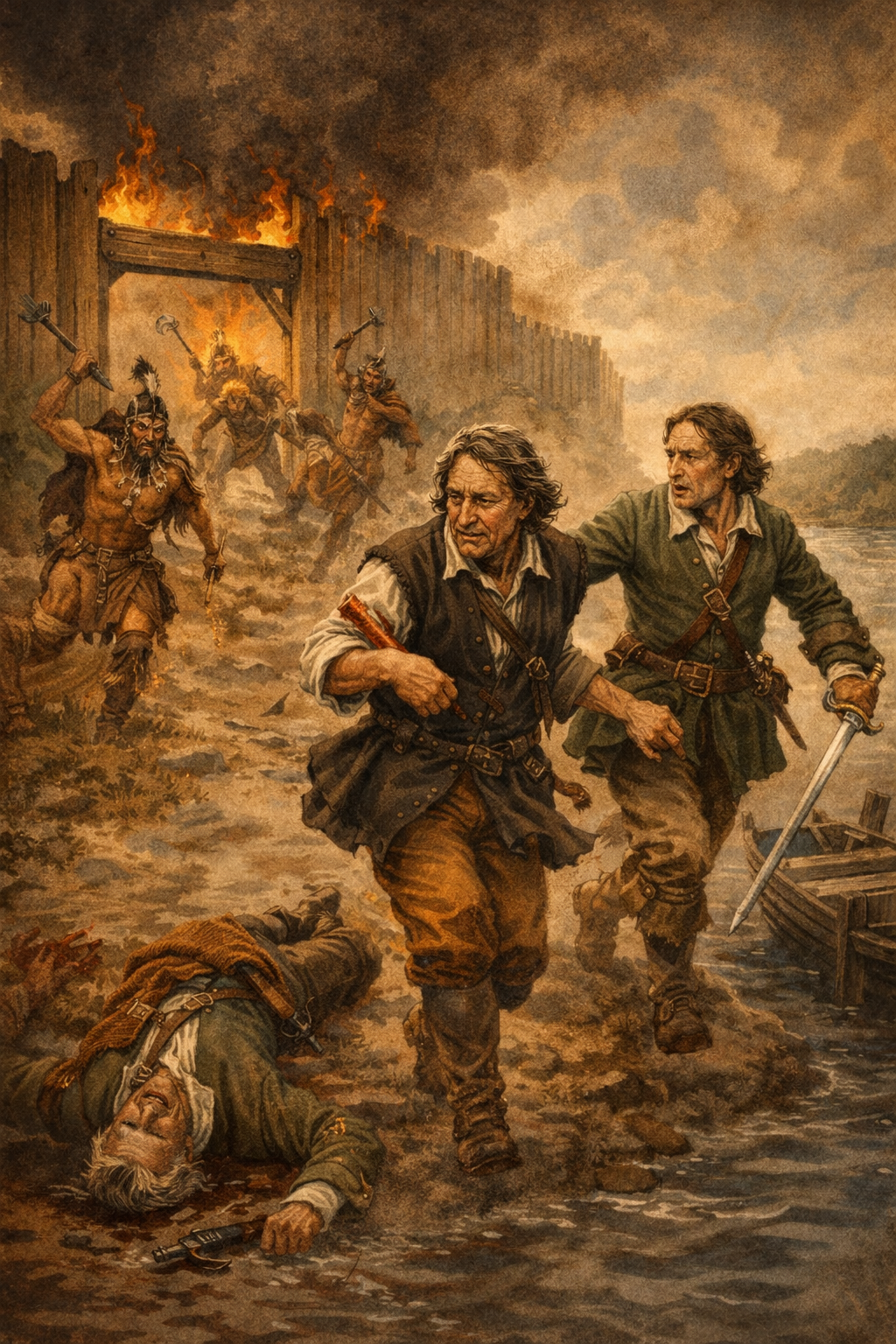
The story involves the dramatic Indian attack on the fort at Arrowsick Island on the Kennebec River during King Philip’s War in 1676. For over a century, historians—including Mr. Whitman in his 1810 history of the Artillery Company—maintained that Captain William Davis, the prominent Boston apothecary and Selectman, was the officer who accompanied the brave Captain Thomas Lake on this expedition. The accepted history told a harrowing tale: on August 14, 1676, Indians concealed themselves beneath the walls of the fort, waited for the sentinel to leave his post, and then rushed the gate. In the ensuing chaos, Captains Lake and Davis fled through a back door to the water’s edge. There, Captain Lake was slaughtered, but Captain Davis, though wounded, managed to make his escape [1, 2, 3].
However, when we examine the probate records and vital statistics, this narrative crumbles under the weight of chronological impossibility. The records prove indisputably that Captain William Davis died of a fever in Boston on May 24, 1676—nearly three months before the battle at Kennebec occurred [4]. In fact, in his will dated May 17, 1676, Captain William Davis appointed his close friend Captain Thomas Lake as one of the overseers of his estate [4]. We even find Captain Lake attending a Boston Selectmen’s meeting on May 29, five days after William Davis had passed away [5].
The confusion stemmed from a similarity in names and titles. The officer actually wounded at Arrowsick Island was Captain Sylvanus Davis [6]. It was Sylvanus who later wrote an account of the war, and whose escape was erroneously attributed to the then-deceased William [7, 6].
Original Narrative from the Source
The following text from the source material details the battle and the correction of the identity of the Captain involved:
“Mr. Whitman (1810) says Capt. Wm Davis ‘accompanied the brave Capt. Thomas Lake (1653) in his expedition to Kennebec, in 1676, and with him escaped at a back door, when the Indians had gained the fort, to the water’s side, where Capt. Lake (1653) fell and Capt. Davis (1643) was wounded, but made his escape.’…
On May 29, 1676, five days after the death of Captain Davis, Captain Thomas Lake attended the regular meeting of the Selectmen of Boston… and this is the last time his name appears in those records. There seems to be no doubt that Thomas was killed by the Indians in 1676, but Captain William Davis could not possibly have been with him because William had died of a fever in Boston before the fight took place.
And now later we have found the following account of the Kennebec Fight which shows conclusively by its date and its wording that it was not our Captain William Davis, the apothecary who was there but a Captain S. Davis, Sylvanus Davis who Savage says was wounded at Arrowsick…
‘On the 14th of August 1676, on the island Arrowsick, early in the morning, the Indians hid themselves under the walls of its fort until the sentinel had gone from his place; then they followed him to the fort gate, obtained a foothold at the port holes, shot down all that were passing up and down within the walls of it, made themselves masters of it, and of all that was within it, Capt. Davis, within the fortification, was wounded there, but escaped.’” [1, 5, 8, 7, 2]
📍 Historical Context & Related Content
Arrowsick Island
Arrowsick Island is located in the Kennebec River in Maine and played a central role during King Philip’s War in 1676. On August 14, 1676, the fort on Arrowsick Island was attacked by Native Americans who concealed themselves and stormed the fort, leading to the subsequent deaths and injuries of soldiers, including Captain Thomas Lake and Captain Sylvanus Davis. This event highlighted the defenses’ vulnerabilities and was emblematic of the broader conflicts between settlers and Native American tribes during this period.Did you know? Arrowsick Island was one of the first English settlements in Maine, and its strategic location made it a critical post for trade and military operations during the colonial period.



Leave a Reply