Archival Transcription
Publication: North Andover Citizen
Section: Out and About
Date: September 19, 1990
Page: 1B
Masthead / Section Header
North Andover Citizen
Out and About
Headline
Search for a local luminary eludes scholars
Deck / Subheadline
Where was the home of 17th Century author Anne Bradstreet?
Byline
By Andrew Spano
Main Text (Diplomatic Transcription)
Until 1960, the town of North Andover believed it had one of the finest intact relics of New England history: the Old Simon Bradstreet House at the corner of Academy Road and Osgood Street.
If you look today, though, you won’t find it.
Not that it disappeared. Instead, it was debunked and is now called the Parson Barnard House. How it got that way involves the work of several scholarly sleuths and points to some even more intriguing mysteries.
The story begins in 1666 with Simon Bradstreet, more or less the founder of what is now North Andover in 1645.
Giving some extra spin to the whole tale is the rising prominence of one of America’s most famous early writers: Governor Simon Bradstreet’s wife, Anne Bradstreet.
She is the one who recorded the disaster which led to the assumption that what is now the Barnard house belonged to the Bradstreets.
In her poem entitled “Upon the burning of our house,” Anne wrote that in 1666 “flame consume my dwelling place.” Besides losing the house, they lost some 800 books and most of Anne’s papers.
The tragedy took place on July 10 at 2 a.m. and was the fault of a careless manservant.
One of the only relics to escape destruction was a single manuscript of her work, which is now in the Stevens Memorial Library.
It was assumed until 1960 that the house at the corner of Academy and Osgood was the house Governor Bradstreet built for himself and his wife just after the fire. The earliest reference to it as such appears in Abiel Abbott’s book “History of Andover” in 1829.
An early historical pamphlet from this century touts the house’s bogus history: “The new home was built in 1667 and stands practically unchanged from its original form… The buttressed chimney has a base of ten feet and… looks like a fortress. It must have been a joy to Anne Bradstreet as she was afraid of fire — no wooden chimney in the new house.”
Everyone assumed this was the truth until the Stevens Foundation bought the house in 1960 and had architectural historian Abbott Lowell Cummings of Salem examine the house.
From looking at the type, style, and workmanship of the architectural details, he found that it could not have been built earlier than 1715. He also discovered, from examination of land records, that it was not owned by Bradstreet but was built by Reverend Thomas Barnard.
Now historians had a challenging question to answer: Where, then, was the house Simon and Anne Bradstreet built after the fire?
Hunt for the house
Cummings wrote in his report on the Barnard house, “Of that original Bradstreet house built presumably soon after the fire, the record is unclear.”
The only evidence in the land records was a vague mention of a “dwelling house” inherited by Col. Dudley Bradstreet in the 18th century.
From his research into the land records, Cummings made his best guess.
“The twenty-four acre lot west of the present Osgood Street is thus credited with a ‘dwelling house’ which may have been the home of Anne Bradstreet,” he wrote.
At this point, an unlikely sleuth stepped in.
Forbes Rockwell of Summer Street in North Andover, alerted to the mystery by Cummings’ report, decided he would do his best to find the spot where the real Bradstreet House stood.
Whereas Cummings had used only land records to locate the probable site, Rockwell wanted to use some hard archaeological evidence.
“I set out to prove him wrong,” said Rockwell, “but in the end he had to concede that Cummings’ guess was as good as anyone’s, even his own.”
But what he found in the process was interesting in itself.
At the time, the ancient North Andover town records were kept in Andover. His first stop was at Mr. Piper, who was town clerk at the time.
“He was a fine gentleman and a scholar, and he gave me the most polite refusal I’ve ever received. He threw down the gauntlet, but I don’t think anything’s impossible, so I got a $2,000 grant from the Stevens Foundation to microfilm the records,” he said.
This done, the selectmen gave their approval to Rockwell and the early town records were photographed by Graphic Microfilm of New England in Waltham in 1961. Henry Stevenson was the engineer.
One of the most interesting things Rockwell found was that Indians in 1696-7 had taken the earliest records of the town from one of the Bradstreet houses where they were stored as part of a vendetta against Indian killer Pascote Chubb.
Chubb was an English army major who had in turn found little sympathy among his own people after surrendering the largest and strongest fort in New England, Fort William Henry in Maine, with barely a shot fired in defense.
The records were then reconstructed and gathered in the “New Book of Old Grants” shortly thereafter using the documents landowners could supply.
This left many precise land lot details lost forever, including those from the Simon and Anne Bradstreet House.
But after methodical research, Rockwell was confident he had found the original land grant.
Probing the ground and digging, he and others found a few relics, such as household implements, melted metal, and burned plaster, which could have dated from the period Anne Bradstreet lived in the house.
Their excitement was soon dampened, though, with the discovery of two big English pennies at the same depth. One was from about 1700 and bore the heads of William and Mary, and the other was dated 1724, putting the site too far in the future to be considered the actual spot of the house built after the fire.
Once again, the place where Anne Bradstreet wrote many of her great poems eluded a diligent sleuth.
The search has befuddled amateur and professional alike, but still attracts the interest of historians and scholars.
Asked why he took up the search, Rockwell said, “This has a purpose. This was a challenge.”
Back in the early 1960s, Cummings knew that in debunking a local myth, he started a search to establish the truth.
“The question of what happened to the house in which Anne Bradstreet lived,” he wrote, “would make an interesting though perhaps futile study in itself.”
Photograph Captions
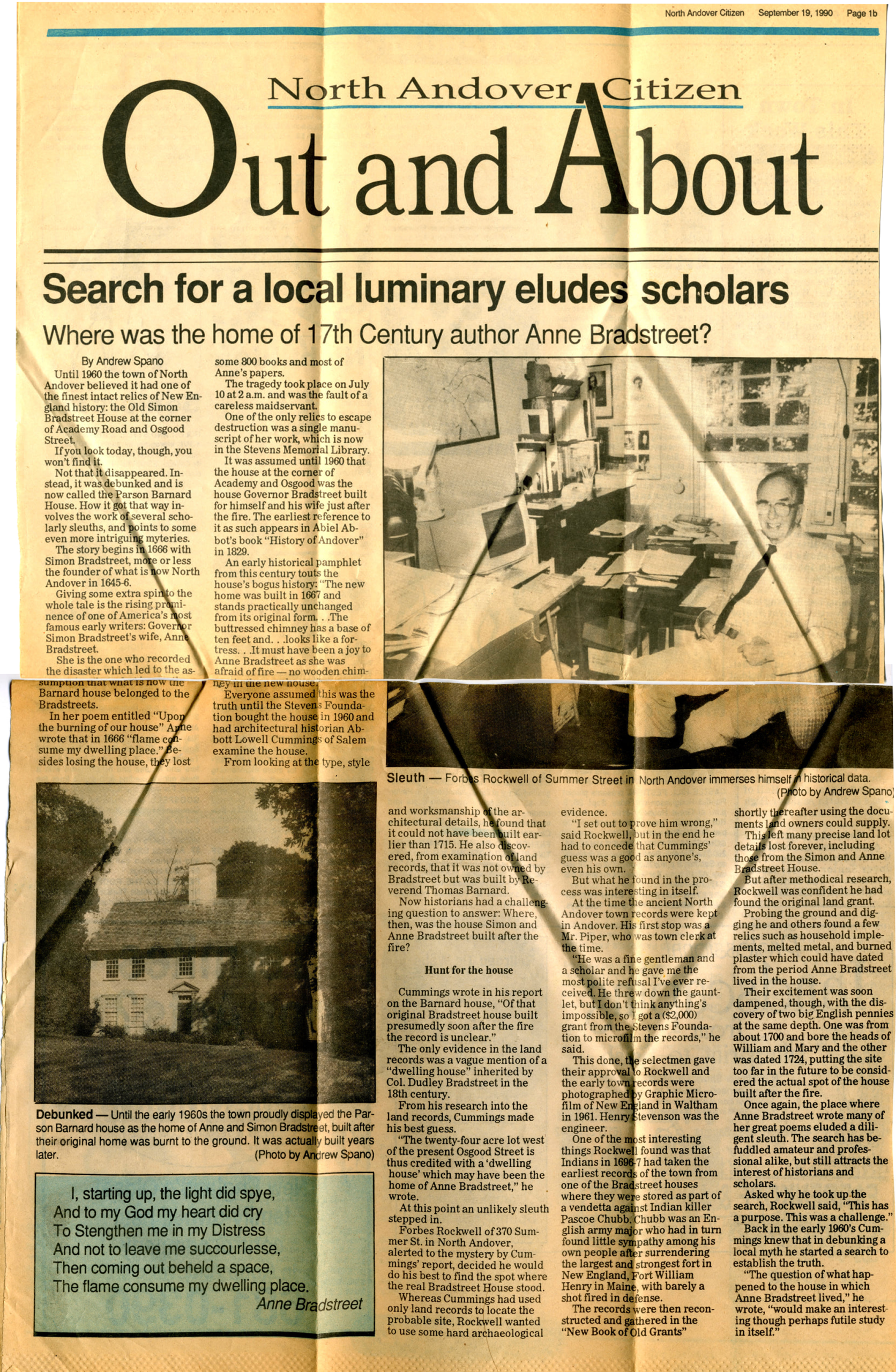
Debunked — Until the early 1960s, the town proudly displayed the Parson Barnard house as the home of Anne and Simon Bradstreet, built after their original home was burnt to the ground. It was actually built years later.
(Photo by Andrew Spano)
Sleuth — Forbes Rockwell of Summer Street in North Andover immerses himself in historical data.
(Photo by Andrew Spano)
Quoted Poem (Boxed Text)
I, starting up, the light did spye,
And to my God my heart did cry
To Stengthen me in my Distress
And not to leave me succourlesse,
Then coming out beheld a space,
The flame consume my dwelling place.Anne Bradstreet
Physical & Editorial Notes
- Full broadsheet page reproduced; vertical and horizontal fold creases visible.
- Photographs reproduced as halftones.
- Spelling and capitalization preserved, including archaic spellings in the poem (“spye,” “succourlesse”).
- Quotation marks and italics rendered as plain text to reflect newsprint typography.
📍 Historical Context & Related Content
Parson Barnard House
The Parson Barnard House, thought until 1960 to be the home of Simon and Anne Bradstreet, actually dates back to around 1715, as determined by architectural historian Abbott Lowell Cummings. Initially believed to have been constructed shortly after a fire in 1666, it was revealed that the house was built by Reverend Thomas Barnard, not the Bradstreets. This historical reevaluation has added depth to the historical narrative of North Andover and its colonial past.Did you know? The house’s chimney, noted for its fortress-like appearance and massive ten-foot base, added an air of resilience to the structure, a feature that Anne Bradstreet, with her fear of fire, would have appreciated had the house been hers.

Leave a Reply