Rockwell, Samuel Forbes. Davis Families of Early Roxbury and Boston. North Andover, Mass., 1932.
In my examination of the historical records regarding the Davis families, one of the most fascinating narratives I have encountered is the legend of Mary Davis, better known to the community as “Old Goody Davis.”
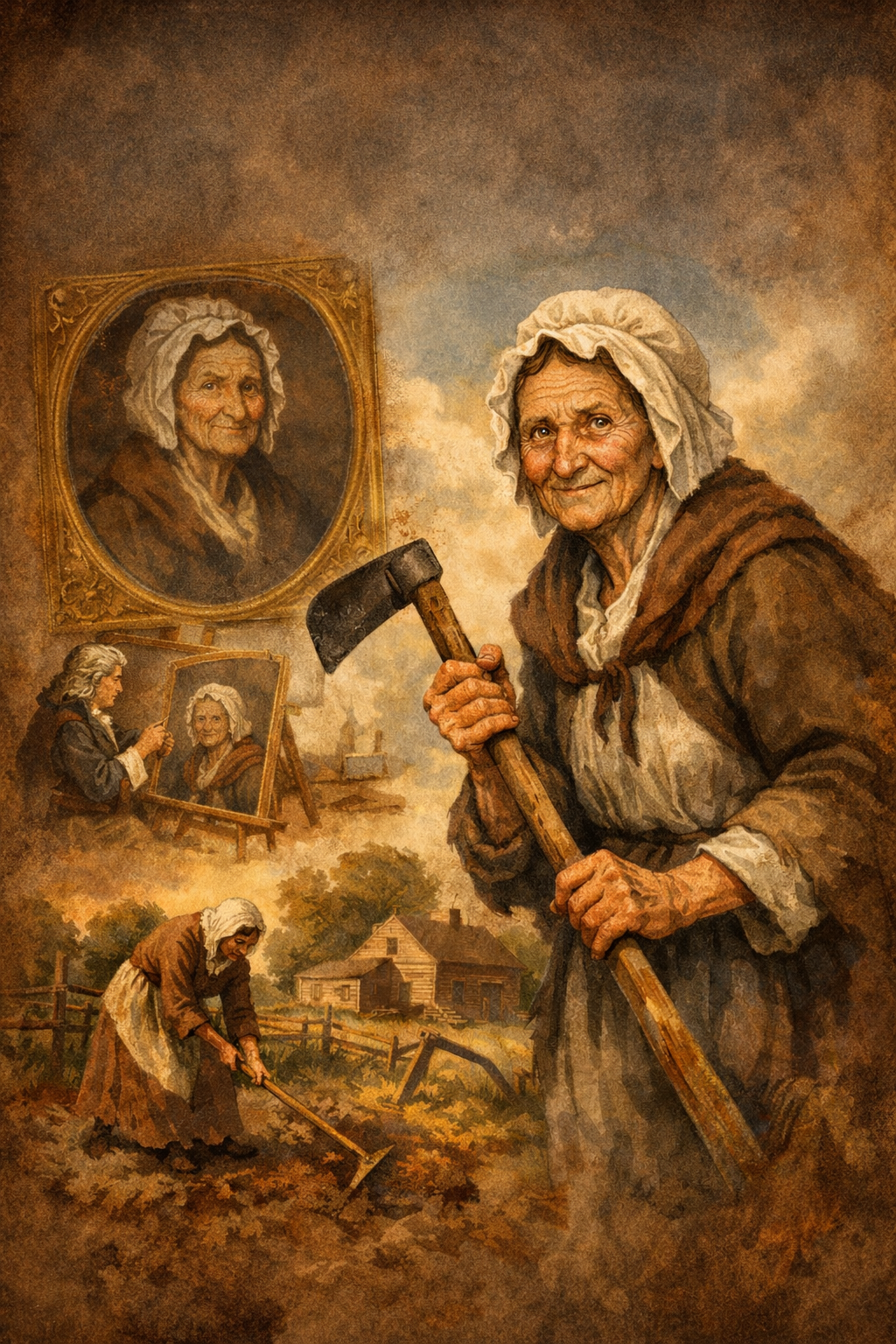
According to the Hyde Manuscripts and the Davis Family Record of 1867, this remarkable woman died on September 23, 1752, at the astounding age of 116 years [1]. She resided in the southern part of Newton, Massachusetts, where she became a local celebrity not merely for her longevity but for her vitality. Even in her extreme old age, she was known to cultivate her own land, wielding a hoe and scythe with “considerable ability” [2].
Her reputation was such that Judge Dudley of Roxbury paid her a visit approximately two years before she died. He was accompanied by a portrait painter who created a likeness of her, an oil portrait that was later housed at the Historical Genealogical Society on Boylston Street [1], [2].
The records indicate she maintained a “good character” and retained both her mental and physical faculties to a high degree until the very end of her long life [2]. During her final years, she was supported at the expense of the town, a service the community reportedly rendered with “peculiar cheerfulness” [2].
As a researcher, however, I must note that subsequent investigations by genealogists Mr. Bartlett and Mr. George H. Williams revealed a case of mistaken identity regarding her surname. They determined that she was not of the William Davis line of Roxbury, but rather the wife of George Davie (likely a brother of Humphrey Davie). The couple had settled in Wiscasset, Maine, in 1663, but after the settlement was broken up in 1680, the widow eventually relocated to Newton [3].
Here is the original text regarding the legend:
“Old Goody Davis died Sept. 23, 1752, supposed to be 116 years old. Hyde Manuscripts.
Oil portrait at Historical Genealogical Society, 1186 Boylston St., near Fens.
She lived at the south part of the town of Newton, Mass., and cultivated her ground with her own hands till extreme old age. She used the hoe and scythe with considerable ability. She was visited by Judge Dudley of Roxbury about 2 yrs. before her death, when a likeness of her was drawn by a portrait painter who accompanied him. She sustained a good character and retained her faculties, bodily and mental, to a very considerable degree until about two years before her death. She was supported in her declining years at the expense of the town, with peculiar cheerfulness.” [1], [2]
📍 Historical Context & Related Content
Historical Genealogical Society on Boylston Street
The Historical Genealogical Society, located at 1186 Boylston Street near the Fens, served as a repository for an oil portrait of Mary Davis, known as “Old Goody Davis.” This society, situated in Boston, has been instrumental in preserving genealogical records and historical artifacts that document the lives of early American families.Did you know? Founded in 1845, the society predates the famous New England Historic Genealogical Society, emphasizing the importance and rich history of genealogy in the region.
Related: See the context of Boston’s genealogy in The Petition for Jane Davis. Tags: Boston genealogy, Roxbury history, historical petition. Categories: Genealogy, Social History.
📍 Historical Context & Related Content
Newton, Massachusetts
Newton, Massachusetts, where Mary Davis lived, was a bustling town in the 18th century, evolving rapidly as a part of the Greater Boston area. In colonial times, it was primarily an agricultural community but grew into an important suburban area by the late 19th century.Did you know? Newton is often called the “Garden City” due to its rich history of beautiful neighborhoods and preservation of green spaces.
Related: Mary’s life in Newton reflects aspects of colonial life similar to those faced by residents of early Roxbury. See The Confusion of the Kennebec Fight. Tags: Roxbury, historical inaccuracies. Categories: Colonial America, Genealogy.
Leave a Reply